


After Mother’s sister Ann died in Detroit, it became clear she needed to live close to one of her children. Rick and I each showed her a few continuing care communities close to us (my brother lives in Cincinnati) and she chose to come to the Boston area in 1995 at the age of 82.
She came off a six month wait list, having passed a physical and financial resource review as well. This was a community with a large buy-in that gave back 90% of the investment when the apartment was resold. They needed to be sure she could continue to afford to live with them for at least five years, based on actuarial tables. She received dinner and some level of care upon entering. As she declined, she could pay for a bit more care, but when needed, she could move over to the Skilled Nursing Facility, continuing to pay her monthly fee (which did increase annually, sometimes by a large amount), and just pay for the extra daily meals. It was 20 minutes from my home, no highway driving required and seemed like a good facility. It was one of the first of its kind in this region. As I did my research, I spoke with one of the founders, who lived in my neighborhood. The philosophy and finances seemed sound.
She was set to move here in December, 1995. I had a wedding to attend in Detroit in November, so flew in several days early and took her on a “grand tour” to visit her surviving siblings in Toledo and Cleveland, not knowing how much longer anyone had to live or when we would have the opportunity to visit again. At that age, life is precarious.
We began in Toledo, visiting my mother’s brother Joe, who had long managed the family jewelry store, his wife Ceil, their two daughters, Judy and Helene, and one of Helene’s daughter’s Jennifer. We had a wonderful visit. They were (and the survivors remain) warm, loving people.
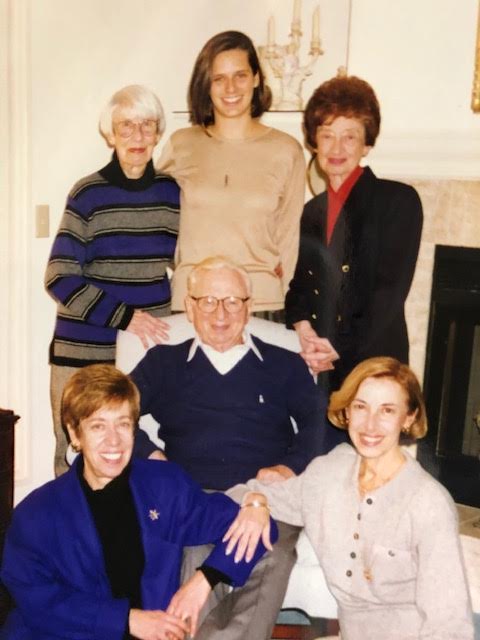
Toledo, 11/15/1995
After lunch, we continued on to Cleveland, where mother’s other sister, Stella, closest in age to her, had married a doctor and settled decades earlier. Stella and Herman had recently moved from their long-time home into a small apartment. We got to see their granddaughter, Lisa and Joe’s granddaughter, Sara Beth, who lived and worked there. We spent the night, having dinner and lunch with them the next day, another stellar visit.
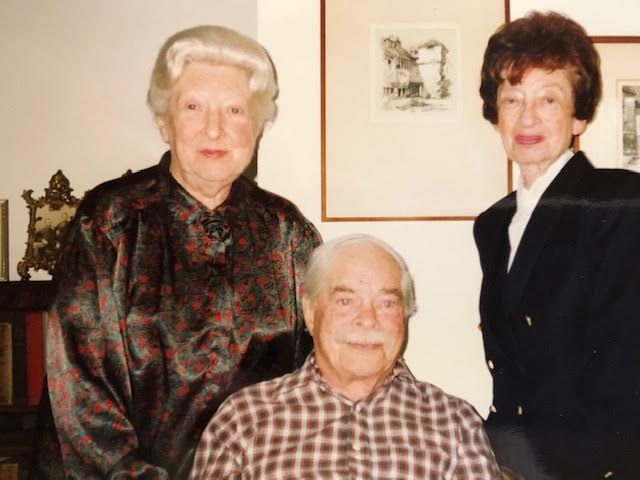
Cleveland, 11/16/1995
After lunch, we drove back to Detroit, dropped Mom off and I went to a paternal cousin’s wedding (my parents divorced in 1981; my father passed away in 1990).
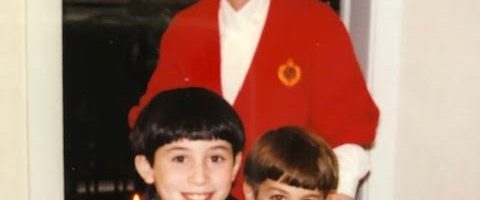
Mother came to Boston (the Featured photo – during Chanukkah) on December 17 and stayed with me until the moving company brought all her things. I had purchased a small couch for her living room, new towels, sheets and comforter for her bed, a small dining table and shelving for her TV and decorative items. I brought as many of her beautiful antiques as I could. I asked for help form our contractor’s carpenter in assembling the furniture. I unpacked her boxes, set up her closet and kitchen.
She lived with us for two weeks until her apartment was ready for her to move in. I went with her as she toured the facility. There was a large auditorium where movies were screened and other entertainment happened almost daily. I made sure she knew how to get up to the dining room. There was a branch of a major bank that had business hours a few days a week. We opened an account for her at a branch near my home, even before she moved in (and they held all her original stock certificates). I was a co-signer on the account. But I introduced her to the banker in her building. I made sure she knew the schedule for the van, so she could go into town to grocery shop. The hair salon was conveniently located in the building. She sold her car in Detroit. She could barely drive on streets she knew. She would never learn a new city.
It was a fairly large complex (six different wings, six floors, one floor connected to Skilled Nursing, but she didn’t want to think about that) and I tried to show her that her key would work at each entrance, what the overall lay-out looked like, where the nursing office was, where the important offices were. It was overwhelming for her. I got her a phone with large numbers and pre-programmed mine and my brother’s numbers. I kept a copy of keys for myself so that I could always get in.
At 82, she was still fairly functional, though the staff told me they had never seen anyone as anxious as she was. It took her a while, but she did learn how to put out her sheets in a laundry bag (they were washed as part of the services provided). She learned where the washing machines and dryers were and how to use them. She eventually settled in. Though I had brought two sets of dishes for her (including her lovely Blue Tower Spode china), she never invited a soul over, or entertained anyone even though she discovered she had gone to college with one of the other residents. It just didn’t occur to her to be sociable.
The head social worker asked me to have her professionally evaluated, so I took her to a neuro-psychologist. Mother was furious with me. She had had a full-on nervous breakdown after we moved from Detroit to the near-suburb of Huntington Woods in 1963, saw a psychiatrist for a time; hated it. She again fell apart during the divorce from my father, threatened to burn our house down and other such things. She would never agree to medication. Despite being bright and cultured, she could be unpleasant and anti-social, very negative. At this point in her life, she was probably in early-stage vascular dementia, but was good at compensating for it. The doctor declared that she had mild depression and anxiety (as I said, she was good at hiding her worst tendencies, even from professionals). The doctor asked me to sit beside her during the final meeting. She scowled the whole time. Finally, he said, “Now turn to your daughter and tell her you love her.” She turned to me and stuck out her tongue. I took care of her for over 15 years.
Mother’s mother died at the age of 90, when I was about 15. She, too, had vascular dementia, though it was called senility in those days. The last time I saw her, she sat in a chair, held there by a restraint. She called my mother “Stella” (my mother was Connie) and didn’t know me at all, despite having once adored me. This was the best care available at that time. I made a silent vow that I wouldn’t let my mother wind up like that. It made a huge impression on me. Obviously the level of care for the elderly had greatly improved in the intervening years and despite the difficulties between Mother and myself, I kept that silent vow.
We had Mother to dinner every Sunday night. We had to drive over and pick her up while I prepared dinner, then take her home after I cleaned up. Dan traveled several days a week, so this cut into family time. She spent every holiday with us. I took her to every doctor appointment (and those increased as she aged). I took her to our CPA to get her taxes done. Eventually, I just took that over, as well as all her bill payments.
We went shopping together. She did get to see her family again, as Sara Beth got married in Toledo and I took her to the wedding (after buying an elegant suit for her to wear to the black tie wedding).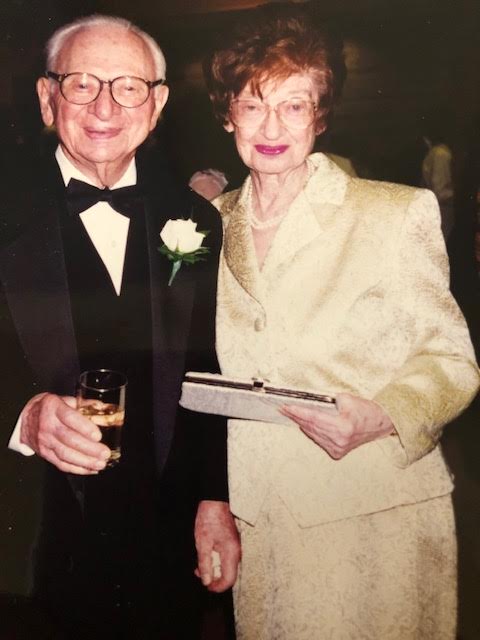
We took her to Cincinnati for my brother’s sons b’nai mitvot. I asked my brother to take responsibility for her during my sons’ special weekends, when I had my hands full with all the other details.
After some years the weekly Sunday night dinner became too much and it became every other week, then we started going out to a local restaurant we all liked. A year after she moved in, we bought our Martha’s Vineyard home, much to her consternation. That meant I was gone for much of the summer. We took her once, but she didn’t want to be outdoors and asked to be driven to a local restaurant, somehow not grasping that we lived IN-TOWN, as close as one could get to all the shops and restaurants. She did not come back the next summer. I always brought Jeffrey home for a week of computer camp in July and spent time with her then.
North Hill (where she lived) did a major renovation after 10 years, adding a central elevator to the ones in the wings and changing the access to the auditorium. This totally confused her. She could no longer learn anything new, though I tried to show her, again and again, how to get to the auditorium. We practiced, but she couldn’t get it. They also swapped out all the washers and dryers. She couldn’t learn those either. I noticed when I took her to the building where her doctors were that she walked with hesitation (though she had no physical ailment). She claimed not to be able to see differences in pavement grades. But there were none, only shadows, or dark patches where new asphalt had been put down. I talked with her eye doctor about this. There was nothing wrong with her vision. I came to understand it was cognition; advancing dementia. She claimed she could no longer climb stairs, though, again, she had no physical limitations. She could not get into our home without the ability to climb a few stairs, so for the last five years of her life, she did not come to our home.
A friend in my choir worked for Jewish Family Services. I spoke with her, she suggested I call them and get the name of a social worker to help me. I did and the woman was enormously helpful. She visited Mother often. Mother loved having someone to chat with. At this point, Mother was on a few medications. We raised her level of care, so a nurse at North Hill came and gave her the medications from a lock box. Someone escorted her to dinner.
The social worker suggested I hire aides to come for 3 hours each day. They would get her up, bathe her, dress her, prepare her breakfast and lunch, grocery shop for her, do her laundry, and on Fridays, take her to have her hair done (the stylists she liked had been booted out of North Hill and set up shop in downtown, I arranged to have the hair dressers bill me. They liked that arrangement, as I actually tipped them an appropriate amount). Unfortunately, I wound up working with two different agencies and had a revolving door of aides coming through, but the system did work. Mother liked some more than others and could be verbally abusive, but it kept her independent a while longer. And between the social worker and the aides, we got her to wear an adult diaper, which had become increasingly necessary. The indignities of the aging.
North Hill had a system to check on each resident daily. There was a flipper at the top of every apartment door. It was flipped up by a watchman late at night. The resident was supposed to open the door first thing each morning to let the flipper fall, so the staff knew the resident was alive and well. If the flipper hadn’t fallen by a certain time, a staff member would use the pass key to enter and check on the resident. In March, 1993, Mother’s flipper didn’t fall. A staff member came in and found her in a heap on the bathroom floor. It was the morning after the Oscars. She claimed she had watched them to the end, gotten up to get washed up, was tired, and fallen asleep on the floor. She was unhurt, but an ambulance took her to the local hospital.
I got a call from the social worker, who had stopped by. We had seen Mother crumble like that before, her legs dropping out from under her. They kept her for two days of observations, didn’t find anything wrong, but said she could NOT go back to her apartment and live alone. She either had to have 24 hour supervision, or go to Skilled Nursing. I had seen other disturbing incidents with her recently, but she begged me not to “put her away”. I had acquiesced at the time. This time it was out of my hands. I consulted with my brother, who, for a moment considered putting a cot in her living room and bring in 24 hour care; super-expensive, intrusive and really not as effective as the Skilled Nursing route. I dissuaded him and he agreed.
I had some of her personal belongings moved before she got out of the hospital. Her social worker, who she really liked, played the bad cop, said it was her decision. North Hill had a good arrangement. She kept her apartment for three months (which gave me ample time to clear it out) in case she could move back. But there was no going back. This was actually during a time when lots of other senior facilities were coming on-line. She was dead before her unit finally sold. Her estate had to be held open to receive the remaining value of the apartment.
In Skilled Nursing, she always had a roommate and that proved tricky. She was not easy to live with and had been alone since 1980. She talked constantly, usually to complain about something. Her first roommate asked to be moved. I heard the family complain about her at the desk, before they realized I was standing behind them. They apologized, but I said that I quite understood. She was close to the desk and would holler at them wanting their attention. Very shortly after moving her to Skilled Nursing, we went out west to visit Dan’s cousin and do some skiing (for Dan). I got a terrible call from the social worker. Mom had aspirant pneumonia (from food going down the wind pipe). She was very sick and very weak. At first it was touch and go, and I almost came home, but she did pull through, though her neck was held up by a collar at first and she had to be spoon-fed a diet of mush.
I came over a lot, particularly as I cleaned out her apartment. I didn’t know that she could have had a top to bottom apartment cleaning once a year. Being paranoid, she wouldn’t allow it, so lots of her nice clothing was moth-eaten and I threw a lot away. I took books and photos albums to my home, gave away good furniture and kitchen ware. The Blue Tower Spode went to Martha’s Vineyard. I would sort, clean and visit Mother. Eventually, she was moved to a room with a deaf roommate.
Skilled Nursing was great for her. They got everyone dressed and into the Common Room every day. They had all sorts of programs, from current events to trivia, to performances. I would help out on Jewish holidays (there weren’t many Jews there, though Arnold Stang was one), explaining the meaning of the holiday and help serve the snack. I became close to the activities director and music director. We worked up a Broadway show tunes program that I performed a few times a year, which the residents enjoyed and Mother would just beam when I performed. I continued to perform it there for several years after her death.
My kids were grown and out of the house as she continued to decline, but I always brought them to visit whenever they were in town. She delighted in their visits. Rick’s son Mike came with his band to perform in Cambridge in March, 2010 and I brought him to see his grandmother. She was wheelchair-bound by this point in her life. This is the last photo that I took of her.
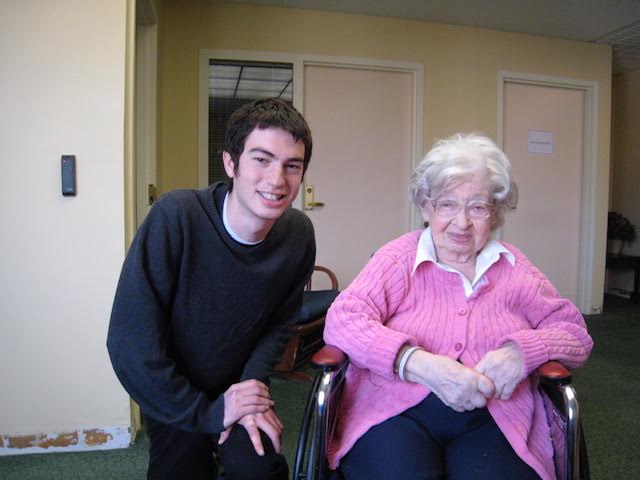
2010 with Mike Sarason
She had become very difficult and had hallucinations, so the staff doctor finally put her on a medication that made her the most pleasant I ever remember her in the last year of her life. I know there are stories about nursing homes “drugging” their patients. This was NOT the case with my mother. After the market crash of 2008, we rented our Vineyard house for 6 weeks the next season, which meant I was around more that summer.
I showed up on the Monday of her birthday (August 17) and was warned by some staff in the elevator that she was in a bad way. She was convinced that Jeffrey, who had a great summer internship in Silicon Valley, had died in a car crash over the weekend and she didn’t have anything BLACK TO WEAR TO THE FUNERAL. She wouldn’t stop crying. I reassured the staff that my child was fine and that my mother was OUT OF HER MIND! I walked into the common room, bearing flowers for her birthday. She was being comforted by the music director. I assured her that Jeffrey was fine, he was working in CA and would be home the next week. This mollified her in the moment, but later in the day, the nurse called and put her on the phone. She needed to be reassured. She couldn’t remember and kept coming back to the hallucination (and that wasn’t the only one, others were even more bizarre). I gave them permission to put her on medication. It worked wonders and, though her memory was failing, we had a very pleasant final year.
In 2010, I came off the Vineyard for my usual July visit, which turned out to be our last. At this point, she knew me but couldn’t remember if I was married (just months earlier, in May, before we left, she needed to be reminded of Dan’s name, but she knew I had a husband). Dementia of any kind is horrible for the person and the family involved.
She had a cerebral hemorrhage while I was on Martha’s Vineyard in 2010. Rick and I were by her side for her final days, as she lingered for six days after the initial event. She died three days before her 97th birthday. We brought her home to Detroit and buried her in the plot, purchased many years earlier, beside her sister Ann and their respective husbands (yes, even though she and my father had been divorced for 19 years, they still owned the grave plots together). You can read more about those final days in What I Didn’t Tell You Then.