
Give Me Just A Little More Time

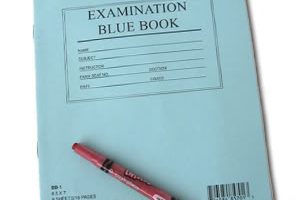
Wow, blue books! So many memories! I considered calling the story “Blank Space” — because there was always a lot more blank space than writing in my blue books — but figured this crowd wouldn’t know the Taylor Swift song, so I went with a 1970 song that applies equally well to my exam-taking experience.

At Harvard, many exams, especially in large survey courses, were given in a cavernous room in Memorial Hall, a High Victorian Gothic structure built in the 1870s to honor the college’s Civil War dead (but only those who fought for the Union). Lots of different exams would be going on in there at the same time, with students sitting at endless rows of long tables. The people sitting near you might or might not be in the same course as you. These exams always seemed to be proctored by the same man, who was known to all as Mr. Goodpeople, because he started every sentence with the phrase “good people.” So he would say, “Good people, you may open your blue books now,” then after almost three hours of silence, “Good people, you have ten minutes remaining,” and finally “Good people, close your blue books and put your pens and pencils down.” He spoke into a microphone, because the hall was so big that it was the only way everyone would hear him. It was pretty intimidating. When my son became a Harvard student, I was amused to learn that this cavernous exam room had been turned into the freshman dining hall, known as Annenberg, so I don’t know where they give exams now.

My worst blue book exam memory is from freshman year, from the most horrendous course ever given, known as Nat Sci 5. I took it to fulfill the one year of natural science that was part of the Gen Ed requirements. The fact that it was a single digit suggested that it was an introductory course, and the title was something about biology, which was the only science I had taken in high school. Unfortunately, it was neither introductory nor strictly biology. All the pre-meds were in this class, which should have tipped me off. After the first semester, I had a grade of C- and I could have dropped it then and taken a semester of some other science. But I knew there was a paper in the second semester, and I always did well on papers, so I figured I could bring up my grade. Big mistake! The second semester was heavily biochemistry, with amino acids, the Krebs Cycle, and god knows what else. I had never taken chemistry and I was totally lost. I did write the paper, and got a decent grade on that, but it wasn’t going to save me. So I went into the final exam with a sense of foreboding, and possibly a few amino acids sketched out on my hand.

The exam had ten questions on it, each worth ten points. On seven of them, I didn’t even begin to understand the question and couldn’t possibly formulate an answer, even a BS one. The other three I actually did answer, possibly with the help of those sketches that may or may not have been on my hand. I also wrote a note in the blue book to the graders, begging them to pass me, because if I flunked the course I would have to take another year of Nat Sci, and that would probably cause me to quit school. We always put stamped, self-addressed postcards in our blue books so that we could find out how we did on the exam – otherwise all we would know was the overall course grade when our transcripts were mailed to us late in the summer. Soon after I got home, my postcard from Nat Sci 5 arrived, saying I had gotten a 29 on the final exam. I was elated! I had only answered three questions, which meant the most points I could have accrued was 30, and I had gotten 29 of them. That seemed pretty perfect to me – I should have gotten an A for how well I did on the questions I answered! What I actually got in the course was a D+, but that was okay with me, because it was sufficient to satisfy the Nat Sci requirement and I was done with science!

My next blue book memory is from a course called Soc Sci 137. It was a general education course about the law, taught by Paul A. Freund, who was a professor at the law school. It was a hugely popular course, with hundreds of students in it. A good friend of mine, also named Paul, was taking the class with me, and when we were preparing our stamped, self-addressed postcards to put into our blue books, he wrote on his, “It was a great experience having you in my class, PAF.” This was obviously a joke, to make it look like he had received this flattering message from the great Paul A. Freund. I thought that was a funny idea, so I did it too. When I got my postcard back, there was another note written under mine saying “I hope it was for you, PAF.” I have no memory of what grade I got in the course, but I was pretty jazzed to get a handwritten note from Freund! I looked for that postcard to illustrate this story, but alas, it must have gotten lost at some point in the last 50 years.

My final blue book memory is from my first exam at UC Davis Law School. UC Davis started out as an agricultural college, and the school’s nickname is the Aggies. When they passed out the blue books, I saw that the honor code was printed on the front, along with a statement saying that we would neither give nor receive aid on this exam. I didn’t have a problem with promising not to give or receive aid. My problem was that the statement we were signing started out “I, _________________, a California Aggie, promise . . . .” You were supposed to print your name in the blank and then sign at the end. I was a city girl, and didn’t like the idea of calling myself an Aggie. I wanted to put in my name and cross out “a California Aggie,” but in the end I left it. I didn’t want the professor to be biased against me when he was grading the exam.

I would have thought blue books would be obsolete now in the computer era, but apparently colleges still use them. I guess they can’t let students bring their laptops into an exam. Even if they turned off the WiFi, the kids could have all the answers stored on their hard drives.
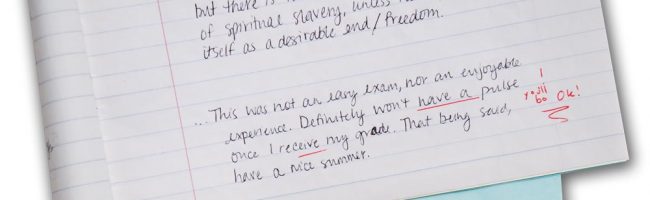
Exams Once Ruled My Life

Exams once ruled my life. Now, having experienced many true tests over a lifetime, I realize that no amount of preparation guarantees a good result. It is what I do with the hand I’m dealt that truly matters.
Read More

A Lot of Lit

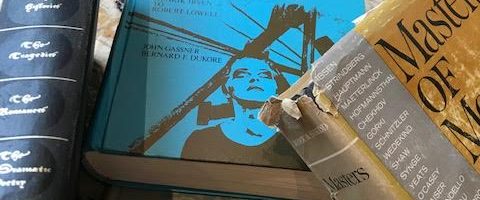
When I entered Brandeis, it still had a General Education requirement, so I had to take courses across varying disciplines, not only in my major of Theatre Arts. I wanted to get all those requirements done quickly, so freshman year, I took French 10 (all literature, read in French), Humanities 1 (all literature), Theatre Arts 1 (all literature) and Math 10 (Algebra). I did a LOT of reading. The syllabus for Hum 1 alone would bring anyone to her knees. I read everything for every course until the very end. I read the Monarch Notes for “War and Peace”. I thought I’d earned it. Hum 1 had papers sprinkled throughout the semesters, but the rest just had one final exam, taken over several hours, written in a blue book; long form answers to thought-provoking questions.

For me, the most challenging course was Algebra. I’ve never gotten along well with numbers. My brain just isn’t built that way. And this course, standard for freshmen, had many sections and was taught by graduate students. Our first teacher was French, spoke with a heavy accent and pronounced “integer” with a hard “g” like “grr”. We had a difficult time following what he was saying and protested. He was replaced by Ron Simkover; a real improvement. He took a liking to me and I sought out some private help as well. I also decided to take the course Pass/Fail. This was a new concept in 1970. We could take one course a semester Pass/Fail (but I would still submit a self-addressed post card so I could find out what my grade would have been; the teacher didn’t know who took the course P/F).

I only took one semester of that course. I studied as hard as I could for the final exam and walked in full of dread. We had three hours and loads of problems to solve. Open your blue books NOW. I solved all I could, always showing my work for partial credit.

I came out sure that I had passed. Relief spread over me. It was also my last exam of my first term. I was done. I spent the evening watching my boyfriend play pinball in the game room of the new student union. Then we went back to his off-campus apartment and I lost my virginity to celebrate the end of the semester and passing Algebra. I had turned 18 a month earlier, so was no longer jailbait.

When the post card arrived, I actually got a “B” in that dreaded class, but it was worth the peace of mind to have taken it Pass/Fail.

There were no exams in my many acting or speech classes. We had to do final scenes or monologues. The scenes were assigned by our professor. We picked the monologues; one classic, one modern. I performed one from “Romeo and Juliet” (“Gallop apace you fiery-footed steeds”) and one from “The Fantasticks” (This morning a bird woke me up”). I still love both.

I took several more Theatre lit classes (several taught by Martin Halpern, Retrospect’s Suzy’s brother-in-law). We covered Ibsen (considered the father of modern drama) through Albee, who was quite current in 1973. Also, a fabulous Shakespeare class. All of those had prodigious blue book exams with thought-provoking questions about some deep topic delving into the readings from the semester. Since we had to write opinions and they were graded by graduate students, I was never sure how they could be graded. Why should someone pass judgement on my opinions?

I loved my Art History courses. The first was a standard survey course from Renaissance through Modern art. The semester I took it, Brandeis experimented and had four professors teach part of it, so Vico Borgo taught Renaissance, Bob Berger taught Baroque and a bit more, Carl Belz taught 19th century and Gerry Bernstein taught 20th century and was my section leader. The exam was identifying slides of famous paintings we had learned about throughout the semester.

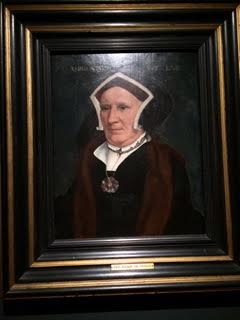
I went on to take two more courses with Vico; Italian Renaissance and Northern Renaissance painting. The final for the latter class was not a blue book exam, but the most interesting project of my entire four years at Brandeis. We had to pick a painting from that era that we could actually SEE and study in person; the provenance, the history of its restoration, how it came into the collection, etc. As a lover of Tudor England, I chose Holbein’s Lady Margaret Butts at the Isabella Stuart Gardner Museum in Boston (they have Dr. and Lady Butts. Dr. Butts was Henry VIII’s court physician, Lady Butts was his wife).

“Lady Margret Butts”, Hans Holbein the Younger. Isabella Stuart Gardner Museum

I did as much research as I could going through sources in the Brandeis library. Finally, a week before the paper was due, I called the Gardner and drove over. This was 1974, long before the terrible theft 29 years ago. It was a sleepy little museum with few staff people. I spoke with the curator who was vaguely annoyed with me. “Not another one of you Brandeis students!” I assured her that I would be the last. We chatted for a few minutes. She was young. She asked if I knew Gil Schwartz. Indeed I did. He was a theatre major who graduated a year earlier and was working improv in Boston (he is now the VP of Communications at CBS and writes business books under the name Stanley Bing). He was also very handsome. She had been at a party with him the weekend before. We made that connection and I was home-free. She gave me a pair of white gloves and full access to the archives. I sat and read the actual letters that Bernard Berenson wrote to Mrs. Gardner when he saw the pair of paintings in England and convinced her to buy them in 1899. I was transported, sitting in a Gothic alcove, surrounded by history and enveloped in the lives of these famous people. Eventually, I went into the gallery and studied the paintings; both of them. I chose to write about the one that had less restoration work done on it through the ages.

This is the gallery from which the Vermeer and the two Rembrandts were stolen, years later. I took it personally. That was MY gallery. I had spent one of the best days of my life in that gallery and now no one will ever see it intact again. I loved doing that project. I learned a great deal. Much more than writing in any blue book.