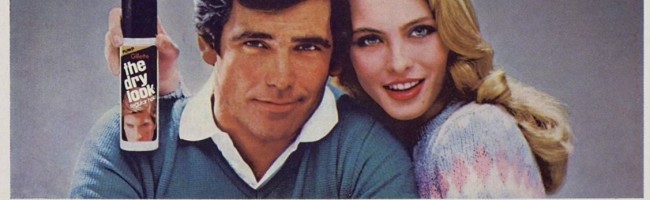



Hair has power. My father knew that, which is why he shaved us skull-tight once a week, leaving him with the controlling interest. Yet he was bald, which didn’t make sense.
Regardless, by third grade, the year I started hitting on women, he let us grow our hair out. The power it gave me was … I have no idea.
What I do remember was that I was required to keep up with my end of the bargain–keeping it combed and neat and combed at all times–unless I wanted it shaved off again; and I couldn’t go back to that, not after making my grand entrance into the third grade classroom, hair combable and slicked back and looking groovy.
But I’ll tell you what, it was a lot of work. And because I was a lazy boy (no other way to say it), I would comb it to perfection at night just before bed, then pull one of my mother’s old stocking hose over my head so when I woke the next morning I wouldn’t have to comb it. Incidentally, after my parents would go to bed, I would also get dressed, shoes and all, so I wouldn’t have to dress in the morning, either. All night, with an itchy head, I worried about my stocking cap falling off, and I was extremely uncomfortable with my Levis and shoes and long sleeve shirt on. It took twenty minutes to turn over in bed; and when I did turn over, I had to get up immediately afterwards, worried that my stocking cap shifted a little, checking its position in the bathroom mirror. Then, when I’d lay back down, I’d wonder again if my stocking cap had moved. Long nights. It reminded me when I used to wet the bed.
So I’d get up the next morning, my stocking cap would have undoubtedly shifted, and my hair would look like someone pressed an iron against my head in several places. I’d have to wet it and re-comb it, and by the time I was done, it was more work than if I would have just gone to bed like a normal kid. On top of that, my mother would make me take off all of my clothes because they would be all wrinkled.
“@$#% Blane! What the hell is wrong with you? Now I have to re-iron them and you’ll be late for school. What the hell is wrong with you?” I don’t know what the hell is wrong with me, I’d say to myself.
It was about that time that I discovered it, the most important discovery in the 60’s–Dippity-Do setting gel, for women. I saw the commercial, I listened to the song, and two days later I spotted it in our bathroom medicine cabinet. I was elated. That morning, I unscrewed the cap, dug my whole hand into it, pulled out a gob double the size of silly putty, and worked it all through my hair. I ran a comb through my hair, effortlessly, making a perfect part, every strand matching the one next to it. I looked close to perfect. The only uncomfortable part was the all the excess goop running down the back of my neck and down my back, but it dried up by the time I got to school.
The best part was yet to come. Within an hour, my hair got hard as concrete, turning into a hair shell, a helmet. If anyone tried messing it up, they’d probably get cut or bruised. It got even better. By lunch I would comb it out, leaving my hair soft, dry, and in perfect shape. I would start out in the morning with a wet look, looking almost perfect, and my afternoon I would look even better.
When the season changed and the days started getting warmer, I discovered one of Dippity-Do’s defects. When I started sweating, my hair would harden up again. So when I came in for recess, half my hair started hardening (the part that got wet) while the other part stayed dry. Since the wet spots were darker, my head looked kind of spotted. Becky told everyone I had malaria. Larry said it was because my head was growing. I was a walking freak-of-nature.
Fortunately, I quickly learned that once it completely hardened again, I could just comb it out, bringing back that 100% dry look, bringing back me.