Actually, even as a lifelong Democrat (my parents indoctrinated me well), I kind of still like Ike.
Read More
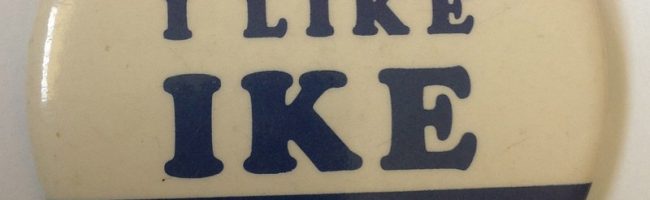
My “I Like Ike” Pin



Actually, even as a lifelong Democrat (my parents indoctrinated me well), I kind of still like Ike.
Read More
This is the first memory piece I ever wrote, long before Retrospect, or taking the Chilmark Writer’s Workshop. I wrote it in 1994, immediately after the events in the story took place and I tucked it away. I had to get my thoughts out. As you can see from the comments below, I’ve shared it once below for a different prompt on Retrospect, but this prompt is perfect, so I share it again with a different title.
In 1994, I begged to differ with Thomas Wolfe who wrote “You Can’t Go Home Again”. I had stayed away from Detroit a long time, but at that moment, I found that it could be instructive, even therapeutic to return home.
I was born at the close of 1952. Eisenhower had just been elected, we baby boomers were everywhere. America was brimming with optimism. My parents brought me home to a small house in Detroit to join a brother, almost five years my senior. The houses were close together and the neighborhood was full of playmates for us.
My best friend lived next door and days were filled playing dolls, first Betsy Wetsy (unfortunate name), then Barbie. I still have my original Barbie and Ken. My dad owned a car dealership and my mother volunteered her time at charitable organizations, as women of her social status were supposed to do. We came home from school for lunch and days seemed happy and uncomplicated. We were not harried or scheduled. We had time to play with our friends and watch The Mickey Mouse Club on our black and white TV. It really was a Leave it to Beaver existence. My memories of that house are pungent: watching President Kennedy’s inauguration, John Glenn’s historic space flight, birthday parties, puppet shows, romps in the snow, staging Peter Pan on our swing set with my brother and the other kids in the neighborhood, raking leaves and the sweet smell of the resultant bonfire. If there was tension between my parents, I wasn’t aware of it. I felt safe and nurtured.
That all ended in 1963. The millage, the tax used to fund the schools in Detroit, was voted down and the choice seemed clear to my parents: private school or move to the suburbs. We moved to an affluent neighboring suburb on October 1 and I have always marked that date as the end of my happy childhood. The kids were miserable to my brother and me, two gawky, smart misfits. I suffered as the cliquish girls made fun of my glasses, buck teeth, lack of bust line, “orthopedic” saddle shoes in an era of penny loafers. My mother had a nervous breakdown and took to her bed. On November 22, three weeks shy of my 11th birthday, I delivered the news of Kennedy’s assassination to my mother in her bed. I was shattered. I had fallen in love with him after seeing the movie “PT 109” (truth be told, I was seriously smitten with the whole Kennedy mystic for quite sometime, but the movie sealed the deal). My father turned 50 the next day and we had a very grim party in our new house. Somehow, that devastating event seemed to epitomized my unhappiness.
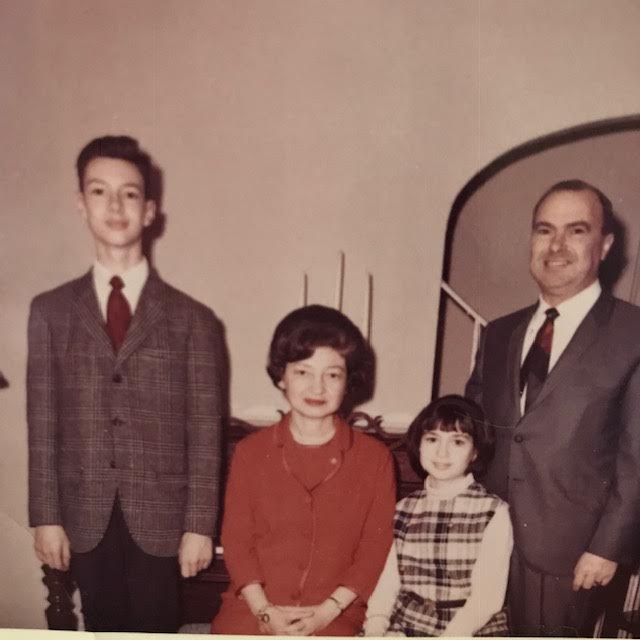
1963
Nothing was ever the same for me. I eventually outgrew that gawky stage, graduated first in my class from high school and went off to an eastern liberal arts college. I married and settled in the east. My father lost his car business in 1967 and my mother’s mental illness finally caused irreparable damage to their relationship, resulting in their divorce in 1981. The tension between my mother and me was never fully resolved, though I moved her to the Boston area 15 years before her death, and cared for her to the end in 2010. Before then, I chose to stay away from Detroit for years and never went back to that little house where I had known happiness.
My kind father, who I still miss so much, died on January 3, 1990 and I began to feel a great need to connect to my past and, more importantly, to share my past with my own two small boys. I began to take them on extended trips to see relatives and favorite haunts from my childhood: the Detroit Institute of Art, Cranbrook, Greenfield Village. I still didn’t venture into the neighborhoods of Detroit. I didn’t know what to expect. One heard so much about the decay of the city, the crime, the poverty. And this was 1994, long before the great recession of 2008! Yet I felt a growing need to see that house again, drive around the block where I learned to ride a bike, where all the kids in the neighborhood would play hid and seek or kick the can until the streetlights came on in the summer. Was it safe to drive around there? I had to find out.
Over spring vacation, 1994, I decided the time had come to return. My boys and I visited my father and his many relatives in the cemetery in Livonia, outside of Detroit proper, but close to the airport, then drove up 7 Mile Road into the city. We passed streets with familiar names where relatives lived before I was born. We found my old elementary school, totally unchanged after three decades. We turned up Briarcliff Road, a block from where Rosa Parks and Aretha are now buried. It looked beautiful, houses well-maintained, lawns manicured. I was told later that the area had private security, but I didn’t know that at the time. Then, before us, was my house. The garage was gone and the backyard fenced in, but it looked the same. We drove around the block and I pointed out the sights, long forgotten: a distinctive Gothic-style house with a vacant lot next to it. The lot had been overgrown when I was young and we were sure the house was haunted. We would hold our breath and run by when we had to cross in front. The lot was now a lovely garden. The house where a baby blue jay fell from its nest and the mother attacked my neighbor when he retrieved the fallen bird. I had told that story to my 4-year old just weeks before. Houses of playmates and family friends who moved long ago. I so wanted to go into my house. I asked my 8-year old for advice. Should I ring the doorbell? How would the owners react?
The mailman walked up the street. I stopped and explained my dilemma. He offered to ring the bell. The man was home, seemed taken aback, but allowed us to enter, “My wife would kill me if she knew I was letting you in. The house isn’t picked up the way she’d like it to be.” I explained that I had moved away 30 years earlier and never returned. I wasn’t there to do a home inspection, I didn’t care if it was tidy, I just wanted to be in those rooms again.
I sucked in my breath. The walls were painted a different color, the carpeting was different, but little else had changed. I walked into the den. The paneling was still there with the window seat my brother and I always fought over. When I was three, he pushed me away so he could us it as a table for his drawing and I, furious at him, walked behind him and bit what I could reach – his rear end! I walked into the powder room. “My wife fell in love with this”, my host explained. There was the little vanity with a drawer. I had put Barbie clothes catalogues in the drawer, my bathroom reading material. I checked to see if the window still had the frosted starburst glass. Indeed it did, evidently to my host’s surprise. My 4-year old was delighted with the discovery as well. The screened-in porch was the scene of many happy summer days. The awning I had crayoned on was gone. My children were stunned. Had their mother ever been so naughty?
Upstairs was intact: my bedroom, where I sat at the open window and talked to the cardinal family that nested in our lilac trees year after year. They would call, “Ricky, rick, rick”. I answered, pretending that they called my brother’s name. I showed my boys the spot where I had rocked over backwards in a small rocking chair outside my brother’s room and cracked my head open, requiring stitches. They had often been admonished with that story.
We went to the basement and my brother’s Cub Scout meetings loomed up in my memory. I pointed out the scrub sink where we carved our Halloween pumpkin, the storage closet under the stairs that served as a shelter during those terrible Midwest tornadoes. The boys were fascinated, but so, it seemed, was my host, whose name, like my brother’s, was Richard.
I recorded the event with a photograph of Richard, his dog and my boys on the front stoop of the house. I wish I knew his full name and more about him, but it was enough that we shared a love for that old house.
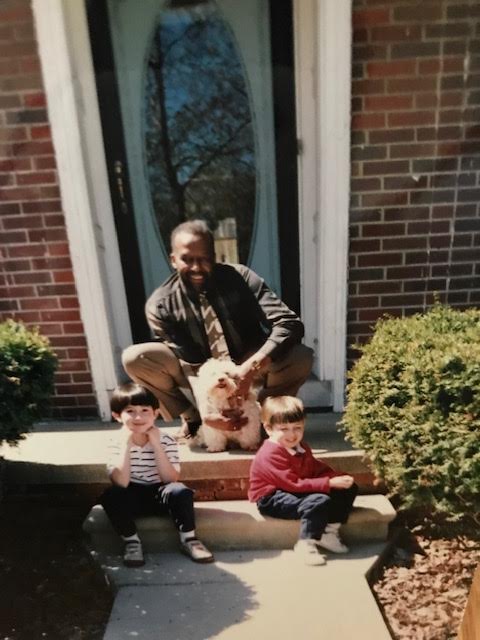
In front of 20209 Briarcliff Rd.
I took my children out to lunch and sat quietly, trying to process what had happened. An image came back to me: the night before we moved, the wardrobe packing boxes stood over my bed, menacing me in the dark. I had terrible nightmares of tall things coming to harm me, a harbinger of the dark times ahead. Then another memory came back to me. My bedroom looked out on the driveway. On the nights when my father worked late, I would lay awake, waiting for him. An indescribable sense of calm and well-being would come over me when I heard his car pull in. I hadn’t thought about that in 30 years. My father now lay in eternal calm outside Detroit, but returning to our childhood home helped me recapture, in some small measure, that feeling of well-being once again.

The flyer—featuring a jolly Santa and offering floor models, repossessions, and a choice of linings—was in spectacularly bad taste.
Read More
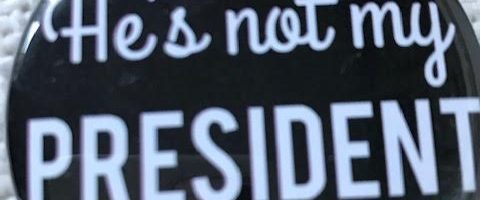
The last time I wrote to this prompt was November 7, 2016, the day before our world turned upside down. In that essay, Born Blue, I described what a proud liberal Democrat I was. And I remain so, though these last two years have sorely tried my faith in humanity.
My husband went to bed at 11:15pm on election night, when the trend was clear, but before the election was called. I stayed up for several more hours, watching with horror as the returns confirmed our worst fears. Both our children share our liberal views. At that moment, our son in London texted. “I know I don’t call often enough. I love you both and will call tomorrow.” It felt like the Apocalypse and that was the tone of his message. Our other child, living in the Bay Area of CA, sat with a suicidal friend and texted suicide hot line numbers all night. It was a grim night in our family, as opposed to eight years earlier when we spoke through tears of joy.
My husband has stopped watching the humor/commentary shows. We don’t watch any cable TV. We get our news from CBS, I watch Meet The Press. We read The Boston Globe, parts of The New York Times, the Wall Street Journal, and from Facebook, I see articles from The Atlantic and The Washington Post. We are mainstream media people. I listen to NPR constantly while driving. I totaled my car a few weeks ago during a discussion on Brett Kavanaugh.
My husband constantly says, “Never underestimate the stupidity of the American people” (with a nod to H. L. Mencken). I listen to some of these people on NPR; heard one interviewed just the other day about the opioid crisis. Her son became addicted to pain killers after a back injury. He stole money from her. Her father died, she was executrix of her father’s estate, but her son knew the PIN code to his bank account and drained it. She lived in Florida and couldn’t get him help there. She voted for Trump and still likes him, thinks he’s “getting things done” (wasn’t specific about what those things are), but wishes he’d get off Twitter. She blames local politicians for not funding better health care (and sees no correlation between state government and all the national rhetoric about repealing Obamacare and clearly does not understand that many states with Republican governors didn’t fund the Medicaid expansion, so did not fund Obamacare properly. Where it was funded, it is working well). She had to move to a different state to get her son into rehab. She said he is clean now and they have a strong relationship. She doesn’t understand how fragile her son’s sobriety is, or how easily is could all come apart if the health care is stripped as Republicans strive to do.
The “tax reform” was a cynical sop to large Republican donors and businesses. Regular folks and low income people got little or no benefit, but it created a huge deficit. Now the Republicans in Congress claim the only way to stem the rising deficit is to cut the social benefits that all retirees depend on (yes, even those who voted for the loud Orange One like their benefits, if they thought about it for two seconds).
Attacks on the press, lying about everything, constantly…that is our president’s stock in trade. Cozying up to strong men and dictators around the world. When we travel to Europe, we are asked to explain what has happened in this country, once the Land of Liberty and the great example for the rest of the world. We shake our heads in exasperation. We cannot explain or justify what is happening. How can anyone separate mothers from their children, some too young to talk, and put the children in cages? It is barbaric.
Words have consequences, as we saw too plainly just days ago with the pipe bombs sent to Democratic leaders and their supporters, including a past president, and the unspeakable mass shootings at the synagogue in Pittsburgh by a vicious anti-Semite. These deranged men (and countless others over the past two years…almost always white, American-born) use the language Trump uses at his Nurenburg-style rallies (immigrants are now invaders). Our Orange Monster is firing up the bread and circus and all the crazies are heeding the dog whistles to fear, hate or kill “the other”. No one is welcome in Trump’s America anymore unless you are white and Christian.
His latest is to overturn the Constitution with a stroke of a pen and say that children born in this country of foreign-born parents are not US-born citizens (or is it just born to illegal immigrant parents; the craziness keeps changing), which would mean, technically, he wouldn’t be a citizen (maybe someone told him that, hence he walked back his first remarks) and therefore, couldn’t be president (only US- born citizens can be president…sorry, Donny – go back to your mother’s native Scotland, if they’ll take you).
He believes in crazy conspiracies, always thinks he is right, lies when what he’s saying is verifiably false, and his base just loves it. Fake news, he shouts. The free press is the enemy of the people and reporters are murdered by our allies while the Orange Monster says arms sales are more important. Nero fiddles while Rome burns.
Whatever he’s done is the biggest and the best. Now he wants to do away with transgenders. As if everything else he’s done isn’t horrible enough, I have a transgender daughter. He is attacking me and my family personally. I have studied how Hitler came to power, freely elected during a time of upheaval and unrest, while Germany had not recovered from World War I and there was desperation and poverty. The Germans looked to a strong man to save them. Shame on those in the US for doing the same.
Recently, I attended a lovely wedding and was seated next to a relative of the bride during dinner. He lives in the Detroit area, so it was thought we’d have lots to talk about. He is also the youngest survivor of Auschwitz, now is an elderly gentleman. He was a charming dinner companion. We compared notes about Greater Detroit, though I have been gone for more than four decades. He told me much of his story (two of his daughters sat across from us). Then he brought up politics. He told me he votes for both Democrats and Republicans, depending on the person, but proudly voted for Trump this time. He saw my face crumple. We didn’t want to fight with one another. He told me he liked what Trump stood for, “America first” (did he not realize this was the term used in the 1930s by isolationists who wanted to keep us out of WWII?), and closed borders. He is grateful for all that America has done for him, an immigrant landing here in 1946, who amassed a fortune, out of the horror of the concentration camp. His mother and her sisters survived, but he witnessed the worst anyone could see. I carefully pointed out to him that I have friends from New York who know Trump personally and will NOT do business with him because he a liar and dishonest. This didn’t bother my new friend. He told me that he saw the kapos, the Jews in the camps who were corrupt and policed the other Jews so they could have a little power and a few scraps more to eat. He said he had seen the worst of the worst, so having a corrupt man in the White House didn’t bother him. He liked the idea of closed borders. “America is the best country in the world. Of course everyone wants to come here. We can’t let them come in.” I reflected on that for a few moments, then thought, “What would have happened if that was the sentiment in 1946 when you came to this country?” But we were at a nice event and I didn’t want to point out his hypocrisy. One can’t reason with someone whose mind is made up.
That is what is so frightening about the current climate in the US today. There is no reason, no thought, education is evil, people feel they are being talked down to, you can’t change minds with facts, there are no thought leaders who are respected. We seem headed down a dark path, perhaps a revolution or new civil war. The less fortunate vote against their best interests because Trump is entertaining and they like his bluster and they want as many guns as they can lay their hands on. The rich like him because he protects their interests. The Evangelicals put up with him because they want to do away with abortion. It doesn’t matter that the law of the land was decided in 1973. It doesn’t matter that they might be stepping on MY rights.
A college friend recently posted this on Facebook: “This morning I and several friends were having our bi-weekly coffee when one of our number made a frightening observation. He is a refugee from Nazi-occupied Austria who was rescued via the kinder transport. He pointed out that he is an immigrant to the US.
“He opened the topic by saying, ‘This feels exactly like 1938.’ He went on to describe how trump’s language and actions (especially that directed toward immigration) exactly reflects hitler’s/goebbels’ talk and actions of that era.
“Friends, be afraid; be very afraid and VOTE THE FEAR AWAY.”
Governing for the good of the country is not what Trump has in mind. He put people in his Cabinet whose express purpose is to undermine their positions and the corruption is the worst in history since the Teapot Dome Scandal of the Harding administration which came just before the Great Depression. Pay down your debt and be careful of the stock market. We are headed for a fall.
Tikkun olam; to repair the world. That is a main precept of the Jewish religion which is why social justice plays such a huge part in our lives. We don’t see that coming from Trump and his minions now (which is why I find it surprising that he has a strong Jewish following). Let us take up this work and be good to one another, listen to one another, learn from one another. We are all brothers and sisters and need to learn to live together in this country and this world. It is the only way forward.