Our differences are what we share -- the fact that we are different, all of us from one another, is how we are the same.
Read More
Required Reading for Living on Earth



Our differences are what we share -- the fact that we are different, all of us from one another, is how we are the same.
Read More
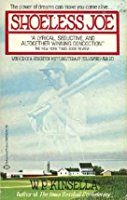 W.P. Kinsella died last fall. For those who don’t know, wrote the book, “Shoeless Joe” upon which the movie, “Field of Dreams” was based. He also wrote, “The Iowa Baseball Confederacy” (along with a slew of other novels and sort stories). Both those books I read on recommendation from my father (who is gone 9 years now, and who was also a writer and huge Red Sox fan). You may think ‘I really don’t care about baseball, so I don’t think those would interest me’, but you’d be wrong. Because baseball is only a vehicle to tell tales of family, wonder, philosophy, legacy, and life. I loved those books. I loved them so much, I wrote to Kinsella after reading “Shoeless Joe” to tell him how it moved me, how I was swept away in the magic and the wonder, how he made me care, how he made me believe — how he made me give a crap about the game of baseball, because when he writes about it he’s only kind of writing about baseball, and even when he truly is writing about baseball, he still makes you love it as though you were born into it.
So I wrote him a letter — and he wrote me back. With kind gratitude, genuine connection, and scratchy handwriting. He wrote me back.
I still have that letter.
It made me sad that he died, because I loved him as a writer. It made me sad because it reminded me of losing my father. But it also reminded me of why I write, and how much I love to do it. Which led me to thinking about the question I keep getting asked at readings and events, “What authors have you read? What were you reading when you wrote this (or that) book?”
I often stumble, suddenly trying to recall all my favorite works. Not because they weren’t memorable, but because I’m a writer, and used to conversing with a keyboard and imaginary people, not a roomful of real ones with all eyes on me.
But Kinsella reminded me. So to answer the question once and for all, here’s a brief list of authors and the works I’ve read and loved. Those that in some way stuck with me and had some sort of influence on my own voice as a writer. Maybe writing them down will help me remember them at my next reading/event. Or maybe everyone could just print it out and keep it with them, so I don’t have to. That would be awesome. But please don’t ask me my favorite part, or, if you read them, if I remember when so-and-so said this-or-that, because my brain dumps old data to make room for new fairly regularly, so chances are I won’t recall. I do recall my feeling when I read them, a sense (or echo) of the experience of reading them, and I know they were meaningful because all of these are still on my bookshelf today, in spite of most having been read too many years ago to mention.
So read on — for my favorite reads, in no particular order, because when I tried to come up with one, well, I couldn’t.
1. W.P. Kinsella Shoeless Joe
Iowa Baseball Confederacy
2. Ralph Ellison The Invisible Man
3. Edward Abbey The Monkey Wrench Gang
Fools Progress
4. Anne Lamott Bird by Bird
Crooked Little Heart
5. Edith Wharton Ethan Fromme and other Stories
6. Katherine Anne Porter Pale Horse/Pale Rider
7. John Irving A Prayer for Owen Meany
8. Robert Pirsig Zen and the Art of Motorcycle Maintenance
(read more than once and until the book fell
apart)
9. Raymond Carver Where I’m Calling From
I’m quite certain there are more, but that is a good overview of what I was reading when I began truly delving into writing. These are the writers that helped me “see” like a writer; to feel life in a way that would lead to words on a page. These are the writers that helped me find my own voice. They are varied in style and content, but the common thread is that each one of them moved me in some way — whether inspired, heartbroken, enraged, encouraged, or just quietly filled with wonder, these books spoke to me, and revealed something about life and the world that I hadn’t noticed before. Like it says on the cover of Shoeless Joe, “The power of dreams can make you come alive”. So can the power of words.
Maybe they will do the same for some of you.
“Baseball is the most perfect of games, solid, true, pure and precious as diamonds. If only life were so simple. Within the baselines anything can happen. Tides can reverse; oceans can open. That’s why they say, “the game is never over until the last man is out.” Colors can change, lives can alter, anything is possible in this gentle, flawless, loving game.”
W.P. Kinsella, ‘Shoeless Joe’
Peace out.
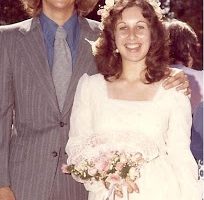
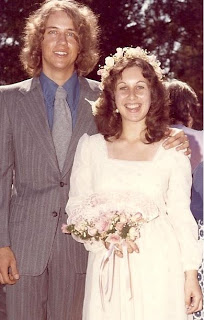
I woke up that morning thinking: today I will glow. I always heard that brides get this special glow you can’t fake or create with makeup, it just happens the day you get married, so I checked the mirror expecting to find it, except it wasn’t there yet, and I thought, well, maybe it creeps up on you like a blush or something, just wait a while for the glow, don’t try to rush it, so I did the usual things to get ready, even used my curling iron, and put on some mascara and green eyeliner because that was the only makeup I had, and we said good-bye to our friend Tom who’d come to town the night before, a friend from college days who needed a place to stay, and we’d said, sure, stay with us the night before the wedding, and then we drove to my parents’ house and they had lox and bagels and I had to eat something, so I ate a bagel and then I asked my dad if he would polish my going-away shoes, or maybe he asked me if they needed it, I can’t remember–but we ended up in his office back behind the house where he kept the black shoe polish and we started talking about getting married and then he asked me to get one of his big books of American plays off the shelf and find Our Town, so I did and I found the part where Mrs. Gibbs says, “People are meant to go through life two by two. ‘Tain’t natural to be lonesome,” and we read that part and a bit of the marriage ceremony, and got kind of choked up and by then my shoes were ready, so that was nice, a private moment– but then it was time to go so I went to my future in-laws’ house where the ceremony was to take place and started getting dressed in the study, with other women coming in and out and offering advice and good wishes, but the first thing that happened was I got a run in my pantyhose, and my mother said it was good luck–I didn’t really believe that, even though it was nice of her to say it–but it was time to get dressed, so I put on the dress I’d made myself: pink embroidered cotton with an overlay of ecru chiffon– a color I had always loved, ecru–and it was long in the sort of hippie style of the day, long and almost sheer, as it turned out, with lace around the neck, a deep flounce at the bottom, and an empire waist, and I wore a wreath of tiny pink roses and a little baby’s breath, and carried a pink fan with roses on it, which had been my mother’s idea, but it was nice and a little different, and that was it: dress, strappy shoes, wreath and fan and the gold bracelet that had belonged to the grandmother who’d died before I was born–but did I glow yet? I think I saw something like a glow, but then it was time for my father to walk me down the “aisle,” which wasn’t really an aisle–in fact, we had to walk through the garage first to get to the concrete walkway down to the front deck of the house where all the guests were sitting, but I was able to make an “entrance” that way, so I took my father’s arm and we walked down the aisle, but he slipped a tiny bit on the way while I held onto him and he said, “I’m glad you’re here to hold me up,” and I said, “Me too,” and as we walked down to where the rabbi and my soon-to-be husband stood waiting for us, my grandfather began to sing, so the rabbi, a family friend, said, “Mike! Shush!” and my grandfather stopped singing, but it made everyone smile at the same time, which was sweet, and then we stood together, the two of us, with our siblings standing up for us while the rabbi spoke; we listened and I couldn’t tell you now what he said, but it was important stuff, and then we said our vows, which I don’t remember either, and exchanged gold rings–mine with a tiny diamond that looked like a star and his plain gold band– and then the rabbi said to kiss the bride and we kissed and hugged and glowed and my new husband smashed the glass and then it was time for pictures and hugs and food and cake and smiling until our cheeks hurt and after a few hours we changed our clothes– I wore a gray suit I’d made, and a black hat for some reason–and we went to a bar for a little while with some friends before heading to the airport for San Diego and a honeymoon at a big old hotel, where we would wake up the next day, look at the rings on our fingers and let it all sink in. Married.
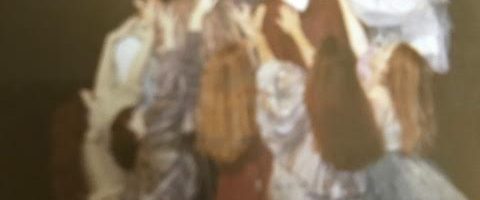
Charlie leered at me, “Hey doll, did you pop out tonight?” Charlie was Charles Werner Moore, a much-respected director, actor, and acting teaching at Brandeis (though I wouldn’t take a course with him until the following year) and director of the first Main Stage show my freshman year at Brandeis. He never learned young womens’ names, calling each of us “Doll”. It was a different era in so many ways.
The show was “The Devils”, based on a novel by Aldous Huxley. It was also made into a movie, released in 1971, directed by Ken Russell, starring Vanessa Redgrave and Oliver Reed. It tells the story of a licentious French priest and disturbed nun during the reign of Louis XIII; perfect for the turbulent, troubled times of political and sexual revolution we found across many college campuses in 1970. At the time, Brandeis had a first-rate theater department, with a large graduate department and many artists-in-residence; professional actors, paid to perform with us and sometimes, teach us. The opulent costumes were rented from the San Francisco Opera Company.
I played a townsperson and was only in crowd scenes. Toward the end of the play, Father Grandier, the licentious priest, is burned at the stake as a heretic. The penultimate scene was a wild orgy under a pulsing red strobe light. For this scene, I changed from my long peasant-girl dress, to a decadent outfit; wool shorts and a tight leather corset…ready for the final scene, depicted in the Featured photo, which I will describe in a moment. In the orgy scene, groups were all over the stage, running around, creating mayhem. I was paired with two large, male grad students. There were no real stage directions…just “go wild; improvise”, and they did. I was a petite, 90 pound freshman and they took advantage of their advanced years, size and knowledge; ganged up on me and came just short of gang-raping me on stage every night. We groveled on the ground, they got on top of me, pushed down my corset, groped me and I was powerless to stop them. I did, indeed “pop out”. Once out, the corset was too tight to stuff myself back in. Charlie loved the action. Since we were at the back of the stage and under a pulsing strobe light, audience members were never quite sure what they witnessed. This was, after all, the era of “Hair” on Broadway, so sort of “anything goes”.
In the play, it isn’t clear to the peasants if Father Grandier is a demon or a martyr. In either case, his remains would have special powers and the final scene found me (as the smallest cast member) held on the largest cast member’s shoulders, holding the charred head of Father Grandier aloft, while everyone flails about wildly trying to grasp at it. That is the photo above, taken by the theater business manager at the final dress rehearsal. I heard Gil Schwartz ’73 (now the VP of Communications for CBS; he died shortly after retiring in 2020) yelling at me from off-stage right to move my arm…he couldn’t see my boobs! That was my introduction to being exposed in public. It was not intentional. On the other hand, I did not spontaneously combust. This was the beginning of public nudity in “artful” settings for me.
Later that year, I sat at dinner with a senior studio art major. We were not alone at the table when he commented that he needed someone to model for him, as he wanted to paint from life. I had gone to art museums my whole life and was well-acquainted with the nude form in paintings, gave it a moment’s thought and volunteered for the assignment. And so began my long career as a life drawing model. About a week later, I was in a private studio in the art building, disrobed and we found a pose that I could hold for a long time and he found interesting to paint. I was seated on the floor, legs extended beside me, torso upright, twisting backward, with a spiral in my spine, looking back. My face was not visible. We spent many hours together until he deemed the painting finished. He started on a second painting, but asked me out on a date, which I thought crossed a boundary. Not related to posing, I became ill, spent a week in the infirmary and the entire project was over, though that one finished painting of me hung in a show of senior art projects.
Sophomore year, a fun group of us appeared in the Orientation Show. A grad student directed it. We had such a good time together, the director decided to continue on with a theater workshop, exploring ideas from other cultures of origin myths and death. He auditioned a large group and winnowed us down to about 10, with a large overlap of those who had worked with him on the Orientation Show. We rehearsed on Saturday mornings and dove into all sorts of touchy-feely stuff, appropriate for the era. Slowly, a show took shape. The first part would be about the creation of the universe, the second act about the destruction of Mankind…heavy topics! These grew out of the work we were doing in our workshop. Our director decided there would be a Mother Earth and Father Sky coming out of roiling masses (everyone on the ground under tarps). By this point, I already had a reputation for being something of a free spirit, so he invited me to be Mother Earth, emerging from under the tarp stark naked wearing nothing but a mask, just as my male counterpart did. In the second act, which was more scripted, the women wore dashikis which we made ourselves. We thought we were so cool!
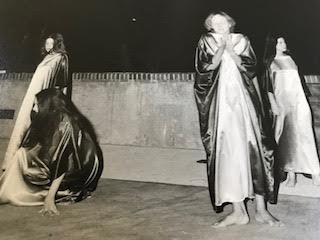
Mourning the loss of Mankind in our homemade dashikis
We performed the show, actually titled, “‘Til, Like a Dream”, but forever called by everyone, “The Outdoor Theater Thing”, outside, on the patio of the Student Union. We performed it twice in early May, 1972. It was COLD out! Students sat on the ground and on the walls. I later learned that some watched from adjacent dorm rooms through binoculars. The only comment that anyone dared make was that I wasn’t large enough to portray Mother Earth!
The next year, wandering around campus, I ran into the campus photographer, one of the all-time great guys. He told me he had taken several photos that evening and made up the photos for me. So yes, a nude shot of me exists, and no, I’m not posting it here!
The theater hired a fantastic scenic painter, one of the best painters I’ve ever met. He decided he would teach life drawing to the design students in the theater and needed nude models for this class. I was still an undergrad and knew everyone in the class, which was a little awkward, but the money was good, so I began modeling for him, about once a month, as described in Posing in 3-D. I continued even after I graduated, though I was now married and worked a few miles away, still in Waltham. The folks in DoD software development found this (and me) quite fascinating. I modeled beyond Brandeis, as friends knew that I was good at it and referred me to other schools. Teachers paid cash. It was my pin money, no questions asked. I remained in touch with the teacher until he retired in 2014. I was the only non-design student to attend his retirement party. At any Brandeis event, he always introduced me as “the best nude model he ever knew”. Actually, high praise.
In the spring of 2002, I got a call from a stranger. He identified himself as a casting director for a movie called “The Strangler’s Wife”. I had never heard of him or the movie. He went on to tell me the name of the director; a good friend from college. They were looking for someone to play the role of a life drawing model in the movie. This was not a paid role, it would be just for fun; one day of shooting on the set. I laughed out loud. “Does Michael remember that I’m 49 years old?” The casting director said, “Michael predicted you’d say that.” “Well, I’m still in good shape, why not?” “Michael also predicted you say that.” “Yes, Michael knows me well.” And that is how I came to spend a May day on the set, again posing nude for a life drawing class in two scenes from his movie (though Michael learned that he couldn’t show pubic hair and get an “R” rating, so I had to allow for that). Movie sets are fundamentally boring, as there is a lot of waiting and down time, then a flurry of activity when the scene is shot, then waiting again. This was a very low budget thriller. Not a good movie. It had one showing at the Coolidge Corner Theater in Brookline, then went to Netflix. (I had friends who sat with a bottle of bourbon and watched it; probably the best viewing option.) The director’s wife found a copy for me on eBay a few years ago. I even have an IMDb credit.
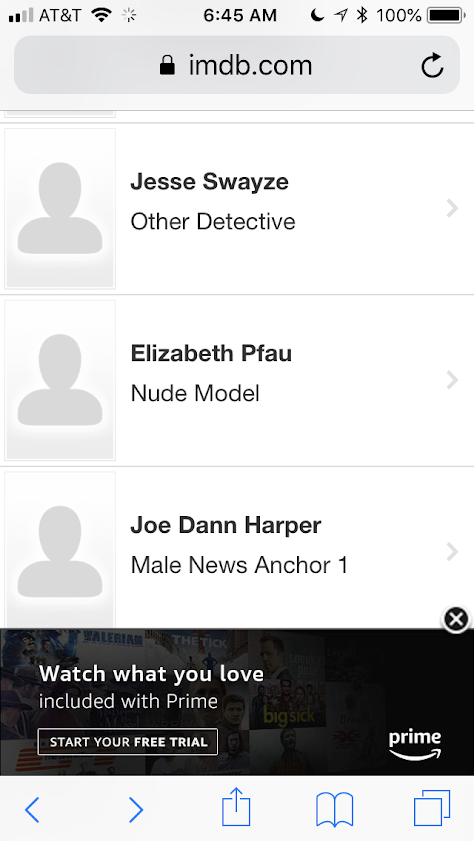
I asked the producer to use my maiden name in case my kids ever got ahold of the movie, but somehow that request got lost in translation. Oh well. Perhaps someday they could be proud that their mother took care of herself, even as she aged. At least one hopes that would be the reaction. We should not be ashamed of our bodies.