

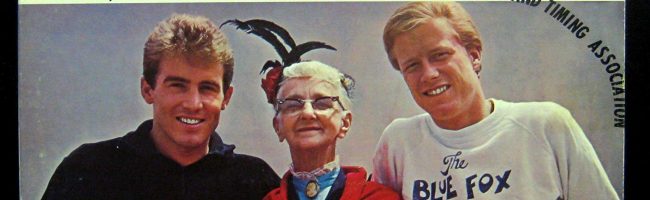
The Little Old Lady from Pasadena

As I often do when I am writing a Retrospect story, I started out by googling “songs about [name of prompt].” For Ageism, I could find almost nothing; apparently it isn’t a topic that songwriters are inspired by. But I did find a reference to “The Little Old Lady from Pasadena” as being the first anti-ageist song ever written. It is a pretty great image, this elderly woman with a flowerbed of gardenias who shuts down all the drag racers. (“The guys come to race her from miles around, But she’ll give ’em a length, then she’ll shut’em down.”) So, kudos to Jan and Dean!

I have been trying for days to think of any times that I have been the victim of Ageism, and I am coming up empty. Of course that’s a good thing, but still, it makes me wonder whether it has been happening and I just haven’t noticed. Up until recently I was always the youngest person in any group — my family of origin, my classmates at every school (because I skipped a grade), even my mah jongg group — but now I am starting to be one of the elders in some circumstances. I am the oldest person in my book group, and recently when I was recommending a book about the solar eclipse of 1914, one of them said, “oh, were you there?” (Notice the year, that is not a typo, it was 1914, not 2014!) When I said no, but thanks so much for asking, she reminded me of the book I picked for the group about Sixties radicals and the Chicago Convention because I was there, so she thought maybe I was at the eclipse too. Just a little ribbing, but I guess you could call it ageist humor, and I didn’t love it.

I recently saw an advertisement for a computer called Wow! designed especially for seniors. Well yes, I am a senior, but I am not an idiot! Here’s some of the text from the ad, with my comments.

“Have you ever said to yourself  ‘I’d love to get a computer, if only I could figure out how to use it.'”
No, even when computers were new I never said that. Also, why didn’t you put a question mark at the end of your question?
“Computers were supposed to make our lives simpler, but they’ve gotten so complicated that they are not worth the trouble.”
Actually, it seems to me that they’ve gotten a lot less complicated than they used to be.
“With all of the ‘pointing and clicking’ and ‘dragging and dropping’ you’re lucky if you can figure out where you are.”
That is probably my favorite sentence in the whole ad, it makes me laugh out loud (LOL) every time I read it. I am very fond of pointing and clicking, as well as dragging and dropping! I do remember when my office first got computers with mice, they encouraged us to play a solitaire program for practice in using the mouse. But that was at least 30 years ago!

So who is this ad directed to? I don’t think it’s Boomers. Everyone I know is very proficient at using computers and doesn’t need one with “buttons” that are easy to see and easy to understand. We may not have grown up with computers, but we have had them since our thirties. This is aimed at my mother’s generation, the eighty- and ninety-year-olds who can’t figure out technology. There must still be some demand for it or they wouldn’t keep advertising it, but I think that demand will disappear very soon, because there will be nobody left who isn’t proficient with computers.

On the other hand, my son, who writes for TV and was perhaps dismayed that we don’t watch much TV in our house, recently gave us a Roku. Not only gave it to us, but came and hooked it up to our TV and programmed in Netflix, Hulu, Amazon Prime, HBO and a couple of others, complete with passwords, so all we have to do is point and click to watch pretty much anything there is. I’m sure we could have figured out how to do it ourselves, but it was so nice to have him do it, and to see how easy it was for him. Was that ageism on his part? You could call it that, but I prefer to think it was just doing something nice for his parents.

To end with another musical reference, Rod Stewart’s song “Maggie Mae” has the line “The morning sun when it’s in your face really shows your age.” When the song came out, in 1971, I thought that line was hilarious, and I would emphasize it when I was singing the song. Now it doesn’t seem so funny, and makes me think about how my face does look in the morning. Of course, I don’t go to bed with college students the way Maggie did. But still. . . .

 

Retreat

Retreat 

A dozen or so years ago my cousin Kathy called me in New York from DC and asked me to join her the following month for a Jewish women’s retreat.

Because geography had always kept us apart,  spending a weekend with my cousin was appealing and a women’s retreat would be a new experience for us both.

Kathy and I arrived on the beautiful grounds of the Pearlstone Retreat Center in Maryland on a Friday afternoon and met the 16 other participants and the female rabbi and young cantorial student who would be our leaders.  By the end of the weekend many of these women would no longer be strangers,  and my cousin and I would feel much closer.

We did so much that weekend – we recited prayers,  performed rituals,  and shared lively communal meals.  We discussed Jewish beliefs and customs,  learned more about the Jewish matriarchs,  and of course debated Jewish feminism.  We mediated and practiced yoga and took nature walks,  and sang and danced and sat in a drum circle making music together.   And we women talked.

We were of varied ages and backgrounds,  a few like my cousin Kathy were children of mixed marriages seeking their Jewish identity.  Among us was a young woman whose wedding would be the following week,   a bereaved recent widow,  several mothers and daughters,  a woman going through a painful divorce,   a pair of sisters,  and a mother whose young child had just been given a devastating medical diagnosis.  As if by tacit agreement,  one of us was always by her side,  talking or just holding her.

I’m not sure what my cousin and I expected on that first retreat weekend,  but we headed home with a stronger connection to our Judaism, and an appreciation of the powerful bond between women.  Kathy and I went back twice since then,  and once our cousin Deb joined us.  Each year we left retreat feeling wonderfully enriched and renewed.

Maybe next year we’ll go back with all our cousins!

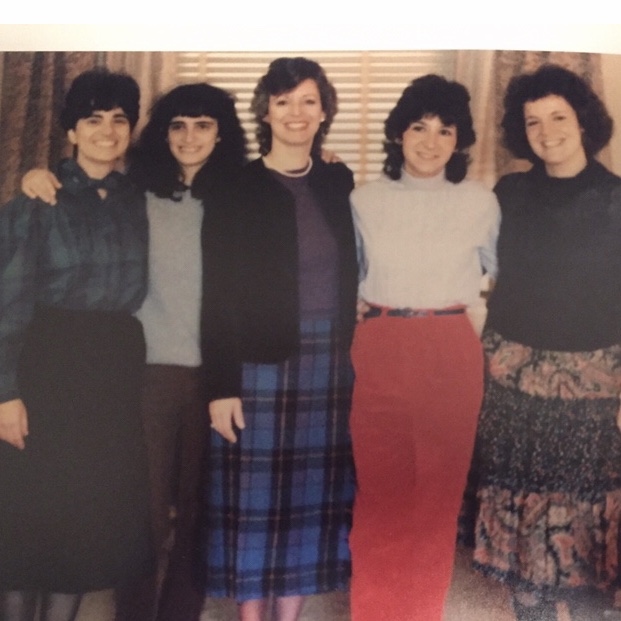
Me,  Laurie,  Kathy, Robin, Deb

– Dana Susan Lehrman 

Surprise Party

Surprise Party

When her husband Andrew was turning 40,  my friend Simi decided to throw him a surprise party in their apartment,  and she asked for my help.

We were both stay-at-home moms then with plenty of free time on our hands for surprise party planning.  In fact for weeks before the party we must have had dozens of daily phone calls back and forth.

We drew up the guest list,  and asked each of our friends to make a dish,  and the food that could be prepared in advance we’d store in Simi’s freezer.  She was a good cook herself and her fridge and freezer were always stocked,  so we were sure Andrew wouldn’t notice anything awry.  Not such a good cook myself,  I offered to bring deviled eggs.

And Simi also asked everyone to bring her their birthday gifts for Andrew and she’d hide them in a back closet they seldom used.

Then we ordered balloons,  a big cake,  and tee-shirts printed for all the guests that read We Surprised Andrew at His 40th!

When the big day arrived,  Simi sent Andrew out on several time-consuming errands so we could set up for the party,  and we’d all be lying in wait to yell Surprise!  when he got home.

But when he did,  the surprise was on us.  Andrew was wearing a tee-shirt that read  I Surprised My Wife at My 40th!

We all laughed,  but Simi didn’t think it was funny. She was mad – something or someone had spoiled the surprise she had so carefully planned.

“How did you know?”  she demanded of her husband,  “Did you see the food in the freezer,  or the gifts in the closet,  or did someone tell you?”

“Actually I didn’t notice the food or the gifts.” Andrew said,  “What tipped me off were all those phone calls you were getting day and night from Dana.”

Well,  I may have spilled the beans,  but at least everyone liked my deviled eggs.

– Dana Susan Lehrman

A Timeline of Life

My wife once read, in what I hope was not People magazine, that our bodies go through a major metabolic change about every seven years. I tend to believe that because, as I think about my own life, that schedule seems to fit. Those seven-year increments can generally be identified by, or associated with, songs, stories or books. Some stir memories, some act as a guide through a stage of life while others prepare us for the path to be traveled.

Birth to age seven is the time of lullabies and fairy tales teaching young minds about the world so full of new things. Sing-along songs and books teach the basics like numbers, animals, shapes and the alphabet.

By age seven most of us are no longer “babies” – at least no longer infants nor toddlers. This is the period most of us remember as our “childhood”. School books, coloring books, comic books and early television were our sources of learning and entertainment.

Around 14 years of age we are assaulted by puberty. Life becomes complicated and can be confusing as we stumble our way toward adulthood. My teen years can be relived hearing early rock and roll songs of the 50’s and 60’s about the drama of life; its highs and lows, of young love discovered or lost. Reading, especially the classics, provides some awareness and direction as we strive for a successful path through life, mostly through trial and error.

Twenty-one marks the beginning of adult life. Over the next 5 chunks of 7 years to about age 56, I married, finished college, began a career and had children. We were busy trying, to the best of our abilities, to live life to the fullest so can’t point to any one thing marking the era for us.

Sometime between the age of 28 and 56 we hit our physical peak. For me, the best I ever felt was at 35 years old. But the decline of physical and maybe mental prowess begins in this period. Initially it may go unnoticed as we slowly begin sliding off our peak while still high enough on the mountain of good health that we either do not notice or are not bothered by the changes.

Hitting 63 marks the Senior Citizen phase of life. Here we become more introspective and begin evaluating our lives and to grapple with our mortality. This stage can be characterized by Frank Sinatra reminiscing about phases of life in “It Was a Very Good Year” or by Harry Chapin’s “Cats in the Cradle”, wherein he decries a fathers regret about being too busy to have a relationship with his growing son.

Now in my 70’s I have lived through 10 these changes and have inarguably entered what are politely referred to as the “Golden Years”. Being at the beginning of this phase I have scant knowledge of what to expect. What changes are in my future? What can I do to prepare, to help me, as I go forward? Nothing comes to mind but, in some old files, I recently found a poem by an unknown sage. I saved it because, at the time I thought it was funny. Reading it now, with age-altered perceptions, it is too close to the truth to be as funny anymore. Still, maybe it can provide some modicum of guidance. Paraphrased, it reads:

The Golden Years have come at last
I’m no longer the man I was in the past
My hearing stinks; my memory shrinks
No hair no more; all my joints are sore
No sense of smell; and I look like hell
I cannot run; I must avoid the sun
I cannot chew; I cannot screw
I cannot see; I cannot pee
So, the Golden Years have come at last
Well… the Golden Years can kiss my ass!