
How My Mother Taught Me to Drive

I had my first accident before I even had a driver’s license. Armed with my learner’s permit, I cautiously drove a few blocks to the A&P with my mother. When, we arrived, she pointed to a spot and told me to pull in there. I did, but I also bumped into the car in the parking spot next to mine. Tears began to flow, but Mom, in her infinite wisdom, calmly told me to back up and try again. I did even more damage backing out, at which point the lesson became how to write a note and leave it under the windshield of the car I dented – twice.

We never made it into the market, but nevertheless, Mom persisted. She wanted me to drive home. But there was no way I was going to attempt to drive again. At least, not without formal instruction.

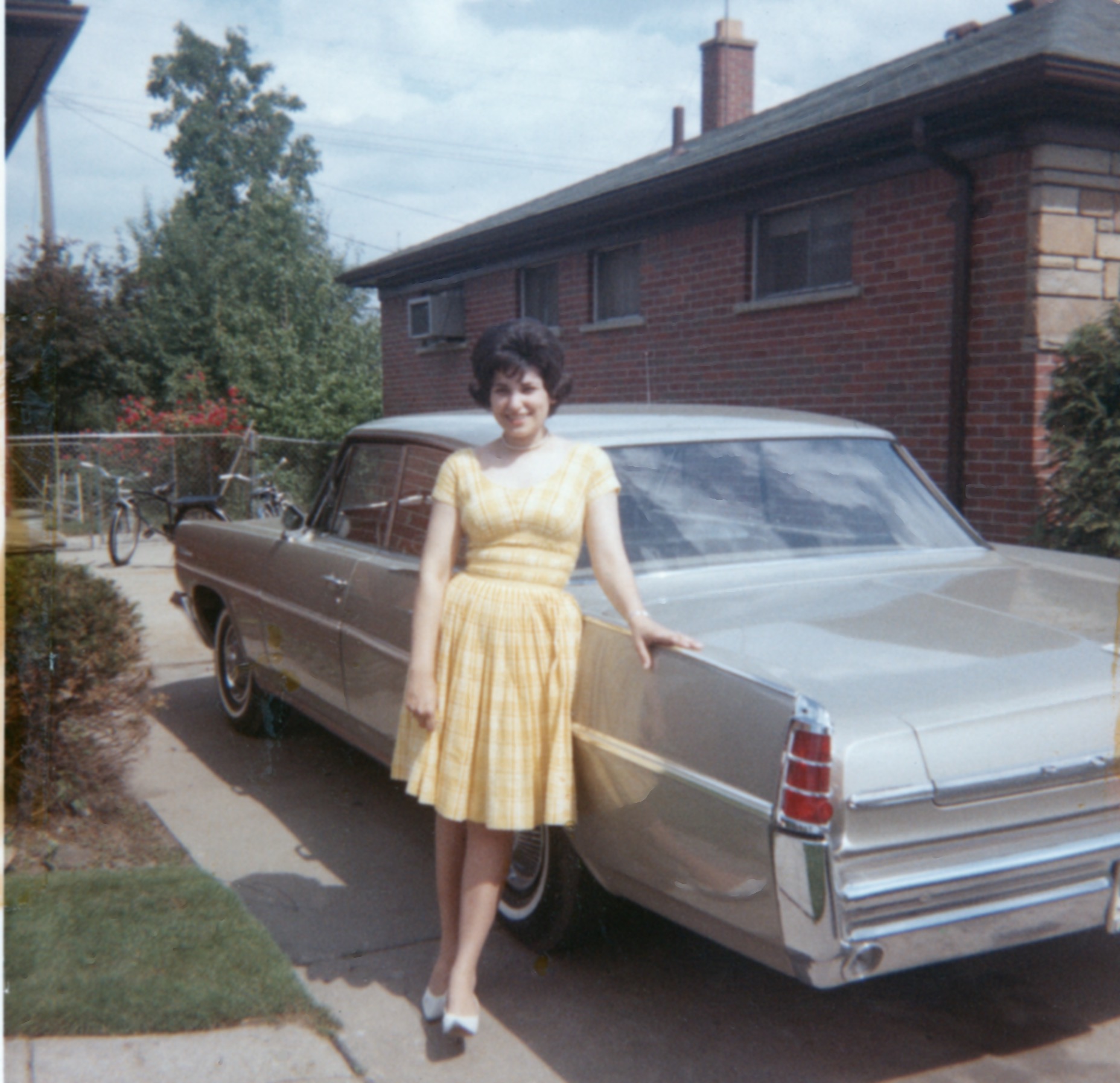
Growing up in the Motor City, my father believed he needed to buy a new GM car every two, or at the most, three years. The thinking was to trade the car in before it developed any problems that would require repairs. Also, having a new car was the symbol of a successful businessman. Here I am pictured next to one of Dad’s cars.
Of course, I was never allowed to drive any of Dad’s cars.  But Mom’s car, well that was a different story. After we moved to the suburbs, a car became a necessity. My mother acquired her first of a string of used cars in the mid 50s. The one I remember best and associate with my first accident was a white stick shift Nash Rambler. You know, the one made famous by The Playmates in their 1958 classic hit song Beep Beep.

My parent weren’t great believers in lessons. If I took them, I took one set to learn how to do something well enough to survive. Thus, six swim lessons at a local pool were good enough to prevent drowning and a handful of ice-skating lessons at the public rink ensured I wouldn’t fall and break something. When it came to driving, the group lessons at my high school were fine.
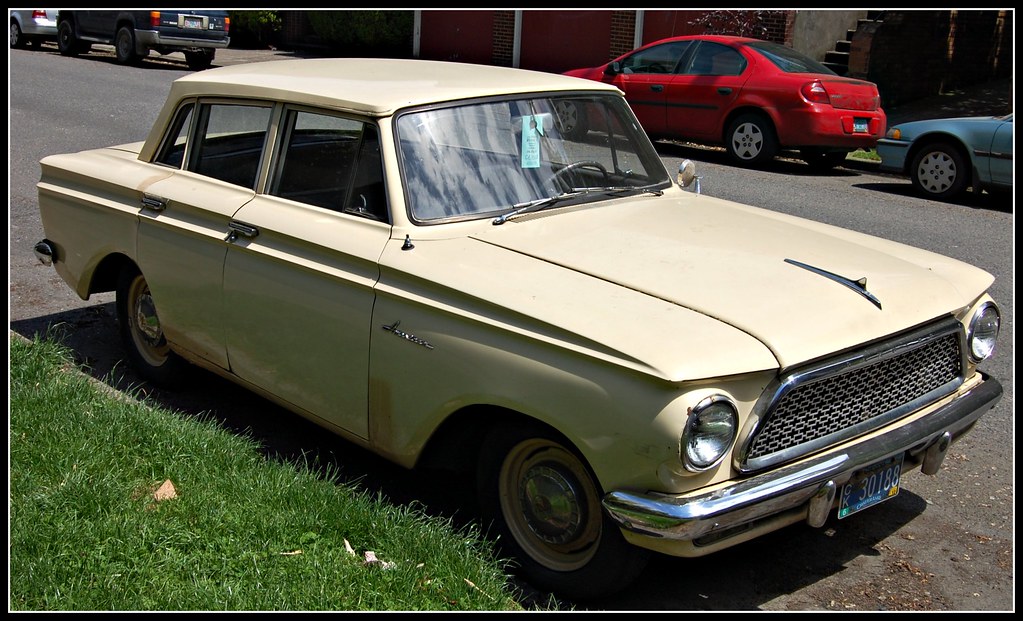
How I remember Mom’s car, minus the dents

I’m sure my father taught my mother how to drive, and now she would teach me. After the fiasco at the A&P, we waited until I had passed my test. The test consisted of driving around the block, all right turns, and pulling into a parking spot. I pulled in so close to the car next to me that my mother had to back out so I could drive home. At least I didn’t dent a car this time, and I guess back then, this fine performance was good enough to earn a driver’s license.

Mom taught me to navigate via landmarks. Turn right after the bagel store. Make a left at the traffic light before the bowling alley. Never parallel park, and stay off all expressways. My driving was limited to running errands for her. Once I was off to college, I didn’t drive again for many years.

After moving to Chicago, and during the early years of my marriage, there was no reason to drive. I didn’t have a car and it was easy to use the El or have my husband drive me places. Ironically, my brother-in-law owned a driving school and I did take enough lessons from him to pass the Illinois test. But aside from my comfort zone of using our family car to buy groceries and drive within a few miles of our apartment, I was happy to rely on my husband or public transportation for longer trips.

Like my mother, moving to suburbia and having kids meant I needed a car. After taking my young kids on a bus to the public library and being unable to find a bus to take us home, I knew it was time. I would have to get a car and start driving for real. Thus began my series of family-friendly station wagons and vans. But none of this made me a great driver. My kids can attest to that. Our Chevy Astro van, a box on wheels, went over many curbs negotiating right turns.

By necessity, I learned to parallel park and I’m pretty decent when I’m driving on familiar roads. But driving by landmarks without any idea of what direction I was headed (other than if I could see Lake Michigan ahead of me, I was going east) made me an anxious driver. GPS navigation made it possible for me to arrive at my destination eventually, and if pressed I will use the freeway, but I’m still uncomfortable behind the wheel beyond the things I learned from my mother’s driving lessons: Stick to the route you know. Don’t change lanes, i.e.: drive in the right lane if you will be making a right turn. Pull over if a car is coming toward you on a side street. Dents and scratches are inevitable.
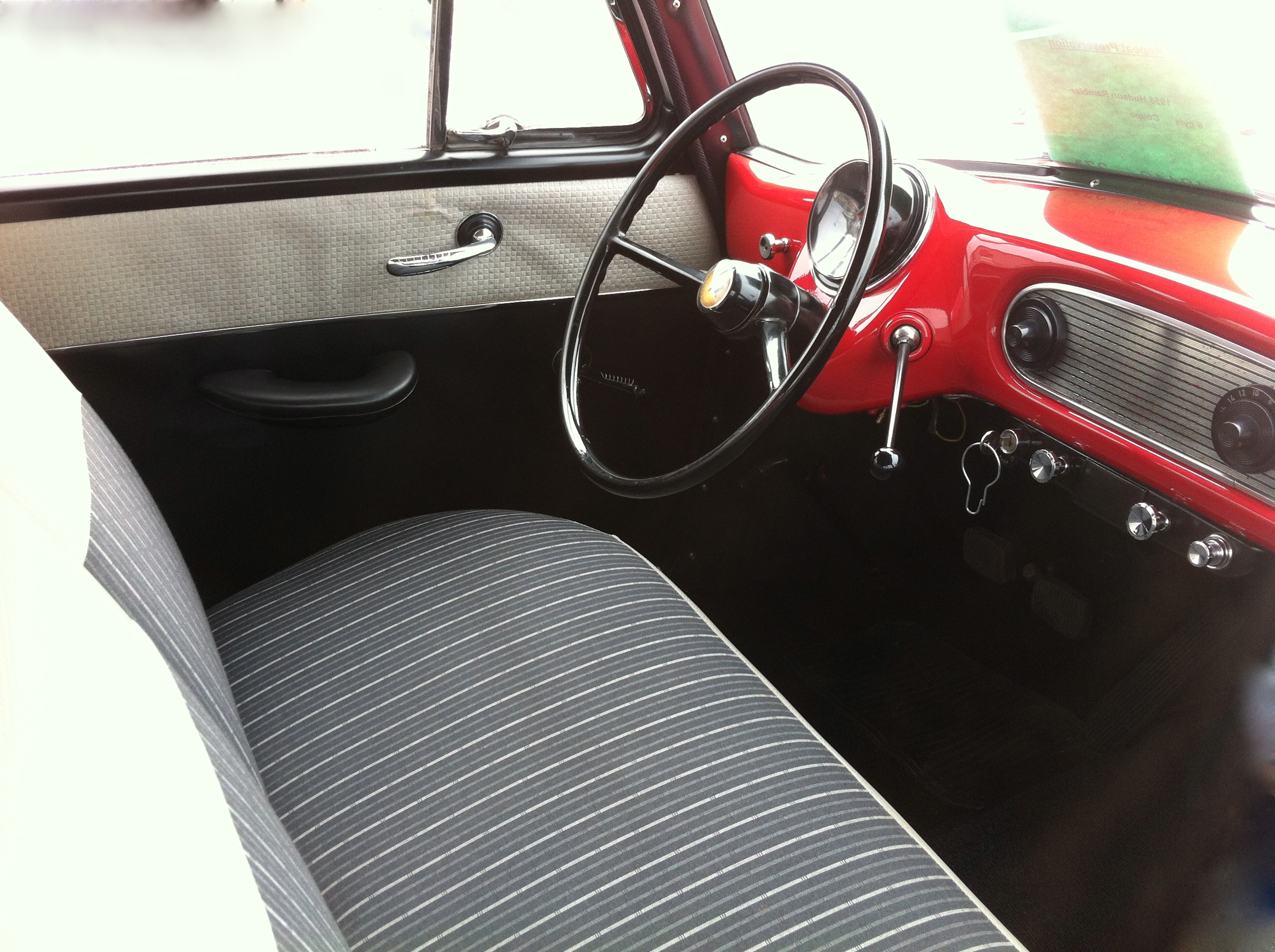
Check out the car I used to learn to drive — bench seat, stick shift, no seat belts

In the Playmates’s song, the little Nash Rambler passed the Cadillac going 120 miles per hour because he couldn’t get the car out of second gear. That would be me. Yes, I learned to drive and spend a lot of time behind the wheel. But before I have to take a road test for my next renewal, I may just sign up for a few more driving lessons. Beep beep.

I invite you to read my book Terribly Strange and Wonderfully Real and join my Facebook community.


A Hard Rain’s a-Gonna Fall

At my elementary school, which I attended from 1956 to 1962, we never hid under our desks or heard the phrase “duck and cover.” We had our own fallout shelter to protect us from the Russians.

The school was a large building, three stories plus a basement, which took up (in my memory at least) a full city block. It had classrooms for kindergarten through eighth grade, although I left after sixth. The basement was where the bathrooms were, so everyone in the school went down there at some point during the day. In fact, the euphemism for “going to the bathroom” was “going to the basement” and it was many years before I realized that most people didn’t say they had to go to the basement when they needed to relieve themselves.

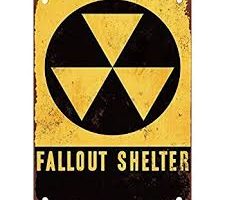
In addition to being the location of the bathrooms, and the music rooms, and the janitor’s storeroom, and probably some other things that I am forgetting, the basement was a certified fallout shelter. It had yellow and black signs like the Featured Image of this story. So just as we had fire drills, where we all had to march outside in orderly lines to a designated place on the playground that was far away from the (presumably burning) building, we also had air raid drills where we marched down to the basement and stood in orderly lines next to the wall until the all clear signal sounded. I don’t remember ever being worried that there would really be a fire OR that there would really be an air raid, I just knew that we had to have these drills so we would be ready if there were.

By the time of the Cuban Missile Crisis, probably the scariest thirteen days during the entire Cold War period, I was in seventh grade at a different school. We didn’t have air raid drills at that school. Again, I don’t remember being worried, although it’s hard to be sure. I have read so much since that time about the missile crisis, I have no idea whether I knew about it while it was happening. I don’t think my parents were talking about it, we didn’t discuss it in my seventh grade Civics class, and I generally didn’t read the front section of the newspaper. So I may have been blissfully unaware of any threat.

An obvious effect of the Cold War was that, throughout my childhood, the Russians were always the bad guys, from Boris and Natasha on Rocky and Bullwinkle (1959-64), to The Russians are Coming! The Russians are Coming! (1966). One year, in some class where we were talking about America being the melting pot, we went around the room and everyone said where their ancestors had come from. When I said Russia, there was a collective gasp. Of course my ancestors had fled from earlier Russian bad guys and that’s why we were even in America. But my classmates were still shocked at the idea that they knew someone who was Russian!

Thinking about the Cold War now, it is amazing to me that I spent those years being so carefree. Maybe I was worried and just don’t remember. I made various attempts at diaries (inspired by Anne Frank), but I no longer have any of them, and I suspect they were more about daily activities than about deep thoughts. Then again, unlike now, those were times when we trusted our government to keep us safe.

  • * * *

A note on the title: Bob Dylan may or may not have said that he wrote “A Hard Rain’s a-Gonna Fall” in response to the Cuban Missile Crisis. That’s what appears on the liner notes of the Freewhelin’ album, but he later denied saying it. And it couldn’t be true, because the first time he performed it was at Carnegie Hall in September 1962, a full month before the missile crisis. However, it makes a good story. He did famously say about this song, which rambles on for many verses on many topics, “Every line in it is actually the start of a whole new song. But when I wrote it, I thought I wouldn’t have enough time alive to write all those songs so I put all I could into this one.” The “hard rain” he refers to might be acid rain, or nuclear fallout, or it might just be regular rain. You never know.


Patricia

We had mutual friends from our high school class on Facebook, so when she sent the request, I accepted. I honestly didn’t remember her from Dondero. She has told me that she was very shy (as was I, but I was busy with choir and the plays). We were never in any of the same classes so our paths never crossed. We came from different elementary and junior high schools.

Now she lives in Arizona, so our paths will not cross.

We must have passed in the hallways and I went to all the football and basketball games, and as many dances as I could, though I had few dates from the school. I would go with friends; my little group. But after we became friends on Facebook, I went back to the yearbook and looked her up. Her youthful face was not familiar.

But Patricia has become a faithful reader of my Retrospect stories and frequently sends me private comments via Messenger; very personal messages about what her life was like and the memories that my stories evoke for her, how these stories resonate, how she processes them. She has encouraged me to share even intimate tales, some of which are difficult to share on a public platform. She sees value in everything I write. We have become close over the years as a result. And supportive.

She takes amazingly beautiful photographs of birds in the wild. I can’t imagine how she gets these images. It is truly art and, as a lover of art, I really appreciate what she does. Privately, we discuss politics, the nature of the sensitive soul, our hopes for this country, everything that friends discuss, and, aside from being in the same building for four years more than 50 years ago, we have never met. Yet we feel a kinship. Retrospect has provided that for us, as she reads my stories, then shares her memories, privately, with me, even some very painful ones and I respond with more than I dare put out there for the public. And we get glimpses of each other’s lives on Facebook, across the great divide.

I recently sent her the CDs from a choir performance from earlier in the year (Haydn and Schubert), as well as the yearbook from our 25th high school reunion. I attended it, but she did not. She is a whiz on-line, scanned it, IDed everyone and posted it to our FB group. Now she has sent it back to me with samples of some of her art. I eagerly await the package. I can’t wait to see her art.

Our 50th high school reunion approaches next year. She and another classmate started a Facebook group for our class. Though I never felt particularly close to many of my classmates during my four years at Royal Oak Dondero High School, Patricia has been my way into that group now. She is leading me back in so many ways, for which I am quite grateful. If there is a reunion, I will definitely attend, so I can really spend time with my Facebook, Retrospect, high school friend.