

Reefer Madness: An Early Encounter with Anti-Weed Hysteria

Martha Lupton Schneidewind was the name of my high school journalism teacher. A tall, birdlike woman, she wore wool suits and ladylike scarves and had a quick, scampering walk. She was kind, loquacious and, to my insensitive teenage self, amusingly absurd with her chirping voice and outdated phraseology.

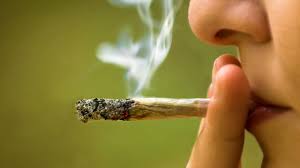
During the mid-1960s, teenage drug use was a huge bugaboo in suburbs like West Covina, Calif. One day Mrs. Schneidewind entered the journalism lab and announced that local policemen had just spoken to the high school faculty about marijuana – a presentation that included the lighting of a joint. If teachers could detect the whiff of weed, the reasoning went, the school could more readily deliver student miscreants to the cops and boost the city’s anti-pot crusade.

“It’s unusually fragrant,” Mrs. S. remarked without a trace of irony when a student asked how the reefer smelled. “Not at all unpleasant.”
Within a few days I was assigned to write an editorial about marijuana for our campus paper, the Spartan Shield. Mrs. Schneidewind didn’t indicate an angle or point of view the editorial should follow, so I figured I had free rein.

I hadn’t smoked weed yet (that wouldn’t happen until the spring of my senior year), but my brother Dan had already been busted for possession and, like most teenagers, I was intrigued by anything that could make masses of grown-ups so freaking scared. There was an immature, forbidden glamour that accrued to drug culture in those days, an excitement that even drug virgins like myself could appreciate from listening to the Beatles’ “Sgt. Pepper’s Lonely Hearts Club Band” or Grace Slick’s piercing vocal on the song “White Rabbit” (“Ree-ee-member what the door mouse said! Feed your head!!!”).

To write the editorial, I referenced a booklet I’d bought at the Free Press Bookstore, a hipster haven in the Fairfax district of Los Angeles. The booklet had a glossary of terms about marijuana (“bomber” was a big fat joint, “pinner” a thin joint), and I naively incorporated those terms in my piece to simulate a streetwise, insider’s perspective.

It didn’t occur to me at the time, and I have no proof, but I suspect my marijuana assignment originated with the West Covina Police Department. I say this because when I finished the editorial and submitted it to Mrs. Schneidewind, she sent it to the assistant principal Barbara Buch for approval. Miss Buch, I now believe, was deputized by the West Covina P.D. to contrive the Spartan Shield editorial.
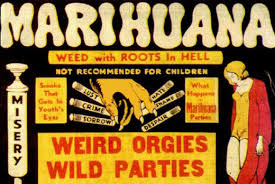
Miss Buch (rhymes with “spook”) was an odd lady. Although it was her job to enforce the dress code for girls – skirts had to be no more than an inch above the knee – her own sartorial style would have to be described as Aging Stripper. She wore a cake of makeup, shaped her eyebrows like arched caterpillars, and favored sexy blouses and wide patent-leather belts that emphasized her generous bosom. According to a persistent campus rumor — total myth, easily dispelled — Miss Buch was a former Playboy centerfold.

I never spoke with Miss Buch, but a day or two after submitting my marijuana editorial I was taken aside by Mrs. Schneidewind. From her desk drawer, she pulled out my typewritten copy and showed me the additions Miss Buch had made to my editorial – additions that totally altered what I’d written.

Among her gems was this unforgettable line: “The casual marijuana user may embark on his drug experiment innocently enough, only to emerge from his ‘high’ with needle marks in his arm.”

I’d never smoked pot or tried drugs of any kind, but I recognized this as anti-drug hysteria. “That sentence needs to come out!” I said. “I didn’t write that and it’s not true.”

“I’m sorry,” Mrs. Schneidewind replied. “But this is final. The editorial will run this way.” Worse yet, it ran that way with my byline attached.
Looking back, I imagine Mrs. Schneidewind felt trapped — that if she had resisted Miss Buch’s edict and defended my journalistic honor she’d be risking her job. I never knew Mrs. Schneidewind to be unethical or heavy-handed on any other occasion – in fact, we remained friends and stayed in touch until she died in 2000 — so I feel certain that was the case. But my sense of betrayal at the time was sharp and painful.

A few months later, I smoked my first joint with Flip Farrall, another member of the Spartan Shield staff. Most weed came from Mexico back then, and when you bought an ounce (“a lid”) it was mostly seeds and stems. Terribly weak. I remember taking long draws on the stuff, trying my best to get a buzz. It took a while to get the hang of it. And no, fergawdsakes, I never woke up with needle marks in my arms.

Today, I still occasionally get high and also use cannabinoid-based medicine for sleep and pain. I feel grateful that marijuana prohibition finally came to an end in California in 2016. I only wish Fraulein Buch had lived to see the day.
Cruise to Normandy

I like history. When I read (now I have eye problems that limits my ability), I read biography. So my husband and I always wanted to tour Normandy and better understand what happened during the beginning of the liberation of Europe. The Americanization of Emily is one of my favorite movies and we agree that the opening of Saving Private Ryan is among the best depictions of the horror and heroism of war ever committed to celluloid.

So we looked forward to our trip with a high-end company that specializes in golf cruises. Dan gets to play some of the great golf courses in the world and the touring is top notch. We have traveled with the company twice before and eagerly signed up for this trip more than a year before the actual dates. It fills quickly and is a small cruise; about 120 people, serviced by a staff of about 60 on the ship and perhaps 8 from the golf company. Everything is top drawer from accommodations and food to the people who provide the history and tours.

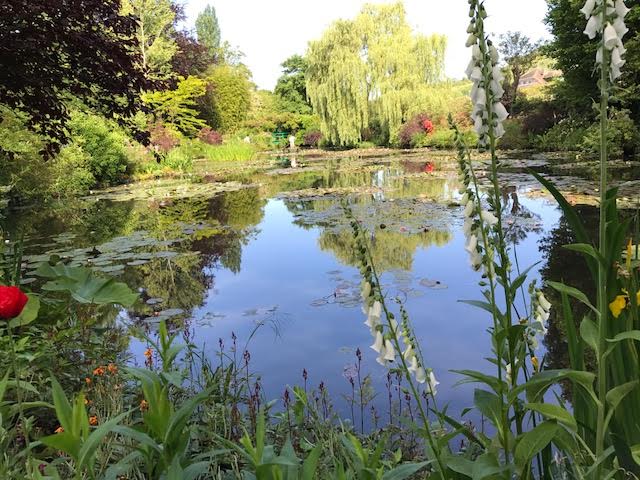
We began on May 28 in a beautiful chateau in Chantilly, France. Spending two days there, Dan played golf while the non-golfers did various tours of local sites. The next day we toured the gardens and home of Monet in Givenry, where he painted his famous water lilies. The gardens remain glorious. We were overwhelmed by their beauty.

.

We continued on and took a quick tour of the historic port town of Honfluer, boarded our ship, unpacked and crossed the English Channel, arriving in Dover the next morning, crossing into a different time zone in the process.

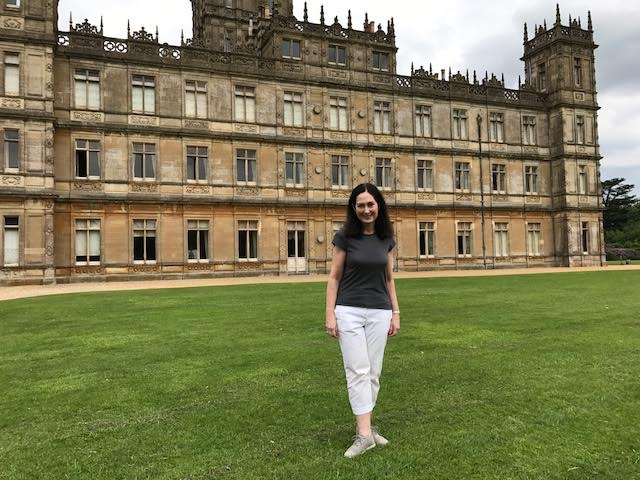
Over the next few days, we went from port to port in Southern England. In Dover, I saw the tunnels where the evacuation of Dunkirk was planned and executed, as well as Canterbury Cathedral, seat of the Church of England and the spot where Thomas Becket was murdered (another favorite movie). Southampton was a highlight, as we had a private tour of Highclere Castle, the actual site where Downton Abbey was filmed. We were greeted in the Great Hall with tea and biscuits (so refined), then broken into two groups and taken on a small private tour. In rooms where filming took place, large photos from the show were on easels. But most interesting were the real, family photos, showing close relations to the royal family (the Queen at a family christening, Diana at a baby naming, and so on). Just fascinating. The furnishings were more plentiful and more beautiful than in the TV show, as much had needed to be removed to make room for the large cameras. We were not allowed to take any photos inside (they had a wonderful gift shop and I bought the guide book to remember everything). We all took photos of ourselves outside.

Portsmouth led us to Stonehedge, which was crowded, with endless lines. But in the afternoon, we went to the historic port and saw a Tudor era ship, the Mary Rose, brought up to the surface and restored. It was fascinating, a modern museum depicting life during the time of Henry VIII.

We went back across the channel that night and began our tour of Normandy in earnest the next day. In all, Dan and I spent four days touring various sites associated with the invasion (the French refer to it as the Liberation and remain grateful to us for our sacrifice and efforts to save them from the Nazis, even 73 years later).

It was now June 2, 2017. We began with Utah Beach, which has a museum. Since we had the time (and Dan chose to not play golf on one day), we saw several British and Canadian landing beaches as well. All have some sort of markers, flag poles, monuments, but there is little to let one know that monumental struggles happened here. The beaches are quiet now.

On nights before we would see something of great significance, our on-board historian, Alex Kersaw (a British ex-pat, now living in the US and author of several books about episodes that take place during WWII) would tell us what we would see the next day and give us hand outs to orient us. His books are well-researched, honing in on personal stories, giving a personal face to the war.

On D-Day eve, a large group decided that we wanted to be on Omaha Beach at 6:32am the next day, just as our own troops actually put boots on the ground. Dan and I decided we had to experience that, so we got up at 4:30am, grabbed the little breakfast provided (our tour people were fantastically accommodating), got on a bus and arrived on Omaha Beach at 6:28am. There was one jeep of re-enacters. It was raining and windy, just as it had been 73 years ago. We stood on the site where our troops landed and observed a moment of silence. Alex led us up the beach, had us form a line, holding hands. He told us how many of us would have been mowed down by German guns at that point. I am not sure I have ever been so moved or grateful for our servicemen in my life. Eventually, everyone on our tour would get to Omaha Beach, but being there at that moment felt sacred.

Ponte du Hoc was a German long gun battery pointed at the American landing beaches. It needed to be bombed before the invasion could begin. The bunker remains, as do the craters in the ground from the huge bombs that fell. The bombing was successful, though Army Ranger had to scale the sheer cliffs, grappling ropes to throw grenades into the bunker to wipe out the remaining Germans, so D-Day could commence. We visited this during a wild wind storm, walking out on the sheer cliff to look over and marvel at our Rangers’ amazing feat. Our group was afraid the wind would take little me right over the cliff and someone held onto me! The next day, we visited Longues-sur-Mer, which has the last surviving German canons. The Americans did knock them out of commission, but left them as a reminder of what we faced. On June 5 and 6, we came across a British and a Canadian veteran at sites, come over for the anniversary. They were both in their 90s. We shook their hands, thanked them for their service. They wore their medals proudly and were amazingly spry. The Canadian told us he fought from Normandy all the way to the Rhine. Amazing.

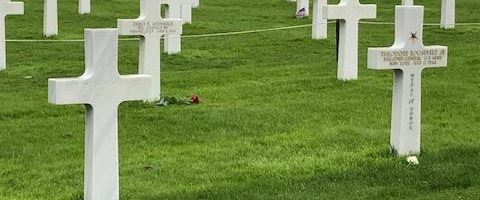
Later in the day, we went to the American Cemetery, where those who fell in the invasion are buried. My featured photo is of the grave of Theodore Roosevelt, Jr, a Medal of Honor winner (hence his cross has the gold star), buried next to his brother, Quentin, who died overseas during World War I. The rows go on forever. My reaction was similar to that of seeing the Vietnam Memorial…it drives home the terrible loss that occurs during war. The cemetery also has a lovely chapel and statue. There was a ceremony going on, since we were there on D-Day, with many wreaths being placed. Our group had also brought a red, white and blue wreath. Our tour leader asked all veterans to come forward and place the wreath at the foot of the statue. Again, I was very moved. Both my father and father-in-law fought in World War II and were very proud of their service.

Alex led us to Ranville on June 7. It holds the British cemetery. His grandfather is buried there. He was on a ship, sunk on D-Day by a German U boat. Alex’s grandmother was 7 months pregnant with his mother at the time. He told us she never got over it. The grave had a card from his mother with a prayer for the father she never knew. More tears from me. I well up even now as I write this, the terrible price of war. We found the British cemetery much more moving than the American cemetery. Instead of long rows of marble with just name, rank and date of death, these graves listed ages and personal messages from loved ones, “We’ll never forget you, Johnny”, “Known only to his maker”. We were particularly struck by the youth of the deceased.

We saw Pegasus Bridge, a strategic point, captured and held by the British for hours so that the troops coming off the beaches could march on into the heartland, battling all the way to liberate Paris, eventually. Of great interest to me was the Caen Memorial, now housing a library, excellent exhibits and a movie, showing the run-up to the war, the reasons, what happened. A very good take. We came away feeling like we learned much about what had gone into the invasion and liberation of Normandy from many perspectives. We continued on to London and a wonderful visit with our son David. It was a great way to start the summer.


A Long, Strange Trip

Thanks to a program that no longer exists, I was able to attend the local college while still a senior in high school. After filling out the necessary paperwork and expressing my urgent need to study Italian—a class not offered at my school—I was approved to begin classes on campus in the fall of 1968. That local college? The Berkeley campus of the University of California.

My TA was a young woman with long blonde hair and big round glasses, who moved constantly in class, waving her cigarette in the air. Back then, there were actual ashtrays in the classrooms, and many of the students smoked. Including me, on occasion. To this teenager, it felt very sophisticated to sit among upperclassmen and practice blowing smoke rings.

One day, a male classmate invited me over to his dorm to get high. Demonstrating my full complement of street smarts and good judgment, I agreed to go. Once in his room, with the door closed and locked, he brought out a joint and lit up. We passed it back and forth and waited for something to happen. When we heard footsteps in the hall, he panicked. “If that’s the RA. . . .” We both knew the trouble he’d be in if we got caught getting stoned. I quickly assessed my options: hide under the bed, or fly out the window of the fifth- floor dorm room. The bed was too low to the floor, but that window . . .

Luckily, the footsteps passed the room where we both stood, frozen, hoping the smoke hadn’t somehow slipped out under the door and into the hall. By this time, I was feeling the effects and was hungry, thirsty, and paranoid. We waited a few moments to be sure, then left his room quickly. Back on the street, he offered to buy me a milkshake. That sounded like an excellent idea. It tasted wet and cold, but the two sensations were separate. As I drank it, I noticed the cold and the taste, but not simultaneously. Weird. And then I started to see the tiny colorful acrobats doing cartwheels ahead of me on the sidewalk. “Do you see that?” I asked him. His reaction told me he didn’t.

I think he walked me to my bus stop, but by then I was too enchanted by the sights and sounds that weren’t there to notice him. I’d been stoned a few times before, but I’d never hallucinated or felt so out of my body as I did then. He left, I guess, and I got on the bus. To get home from Berkeley I needed to transfer to a second bus, so when my first ride ended, I stepped off slowly and tried to maintain. But at this point, on a busy corner of University Avenue, I sank to my knees and uploaded that milkshake into the gutter. Did anyone notice? Would a passing policeman grab me for being a vagrant? Paranoia had me in a panic.

The bus I wanted came and went. The signal to cross the congested street changed several times while I waited, rooted to the sidewalk, certain that if I stepped off the curb I’d be flattened by a truck. Time slowed down as I pondered the best way to get across the street and not get run over. I thought I was stuck there forever, unable to cross four lanes of traffic safely.

Just in time, a friend from school happened by and led me across. We were catching the same bus, and once we got settled in I said, “I am so stoned. I can’t possibly go home now. My mom would kill me.” She said, “Come home with me, sleep it off, and we’ll figure something out.”

We walked to her house from the bus stop, a short walk that seemed to last forever. Her father was home, but she waved him off with a story about my terrible headache. I collapsed gratefully on a bed, and fell into a deep sleep. When I woke up and felt a little more like myself, I called home and told my mother I’d been invited to stay for dinner at my friend’s house, and would get a ride home later. All was well, or almost well. My friend’s dad may have picked up on the real story, but he didn’t let on. I am grateful for these acts of kindness to this day.

A couple of days later, back in class, I told my TA what had happened and pointed out the guy who’d offered me that laced-with-who-knows-what dope. She called him over, made him apologize, and read him the riot act in two languages. She was livid as she stuck up for me, knowing full well that I was still basically a high school kid and presumed innocent. If good judgment comes from experience, and experience comes from bad judgment, I learned a lot more than Italian that quarter.

For years afterward, the smell of marijuana set my teeth on edge and made my stomach flip. In those days, in Berkeley, it was hard to avoid that unmistakable acrid aroma. It seemed to be everywhere when young people gathered together. I would hold my breath and try to move away from the smokers, but it wasn’t always possible at an outdoor concert or an anti-war demonstration.

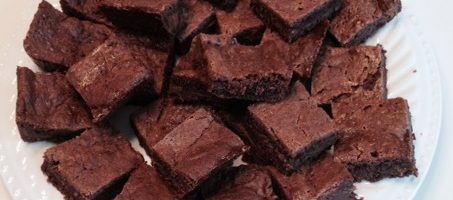
It’s been interesting to reflect on this experience now that the legalization law in California—where I still live—has taken effect. I doubt I’ll be tempted to light up any time soon, though. In recent years I’ve nibbled a brownie or two with mixed results, to be honest. Legal or not, I’m not sure the appeal is there anymore. I won’t be smoking, that’s for certain.  The truth is: The days when I would eagerly inhale ended on a long, strange trip during a sunny spring afternoon in Berkeley nearly fifty years ago.