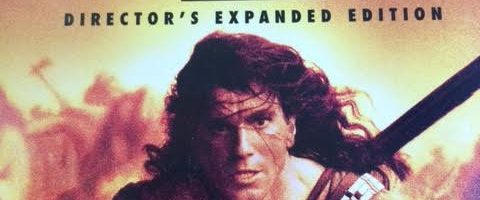
I love movies. But I had never loved a movie star; not until Daniel Day-Lewis swept me away in The Last of the Mohicans. Actually, it is my husband Dan who claimed that I was in love. An old friend referred to my condition as obsession. She would know. She’s a therapist. That didn’t stop her from sending me a larger-than-life movie poster from Mohicans. At Dan’s suggestion, we framed it and hung it on a prominent wall. Now I could gaze at Day-Lewis’ intensely handsome face whenever I needed romantic inspiration. Lucky for me that my husband and beloved shared the same name. It made things less messy. My mother-in-law thought the two men looked alike. Let’s just say their coloring was similar.
I couldn’t label what happened to me. After the first viewing of Mohicans, I was so pumped with adrenaline that I couldn’t sleep. I had to see it again and approached Dan about going to a late show alone after our two boys were in bed. He was bewildered, but agreed. I was unprepared for my emotional response. I was not ordinarily a frivolous person. Before we had children, I was a well-respected, highly paid tech sales representative. We had been married twenty years at the time. I turned 40 during the peak of my Mohicans madness and sage friends nodded their heads: “Mid-life crisis”, they concluded. All I knew is that between Thanksgiving and Christmas Eve of 1992, I saw the movie seven times. The movie had been released months earlier and at this late date, the theater was almost empty. I held silent communion with Daniel Day-Lewis in the darkened house. Two months later, I missed it so much that I traveled some distance to see Mohicans at a second-run movie theater before it disappeared into the small screen Neverland of video and cable TV. I found that I had company. The book editor of Glamour confessed in print: “I owe a lot to this man. I’m convinced I got pregnant after seeing The Last of the Mohicans three times.”
Daniel Day-Lewis is described as the thinking woman’s sex symbol. At least I’m a “thinking woman”. It’s more dignified than being called a “love-crazed fan”. During the first winter of my passion, I immersed myself in the life and times of this man. I rented videos of anything he’d ever been in, even Sunday, Bloody Sunday, in which he appeared for 10 seconds as a 12 year old car vandal. I became fascinated by his smoldering performances, even though many of those early films were awful. I had studied acting seriously, been a theatre major in college, but knew that my talent never approached his. I marveled at his transformations. Though he was already an Academy Award winner, I preferred to think that I had just discovered him; I was the only woman who really appreciated him. I needed to know more about this brilliant contradiction of a man; so shy and serious in print, yet able to assume anyone’s shape on celluloid.
In his interviews he spoke of his late father, Cecil Day Lewis, the poet laureate of England, so I bought the complete volume of his poetry, edited by Daniel’s mother, the actress Jill Balcon. I snuck off to my study to read this poetry and was astonished at my sensual response. I loved it and craved more. Reading The Buried Day, Cecil’s autobiography, gave me context for the poetry, but the book ends in 1940 as Day-Lewis’ father leaves his first wife and children, long before this family comes on the scene. I felt compelled to write to Jill Balcon for more information. After all, in her introduction to the volume of poetry she had written: “I am touched myself when friends, and often strangers, quote passages of Cecil’s which move them and, moreover, sustain them.”
With trembling hands, I tore open the aerogramme from London to find a handwritten response: “Dear Mrs. Pfau, Thank you for your letter. I cannot possibly enter into private correspondence with you: I have at least 100 letters a week (& and my son far more) that do require attention, & more work of my own that demands a great deal of me. Yours sincerely, Jill Balcon”
The letter was bracing. Reality had intruded on my fantasy life and I didn’t like it one bit. I imagined a satisfying scenario: “I would like to thank the Academy for this award honoring my screenwriting. I owe my inspiration and drive to Daniel Day-Lewis’ mother, who once told me that I was unworthy of her time.” I put away the father’s poetry. I couldn’t bear to look at it.
The son was another matter. The more I read, the more I longed to know him better, but he deliberately remained an enigma to interviewers. He only revealed little bits of himself, then contradicted himself in later interviews. As the years went by, he became increasingly wary of the press as his career hit peaks and valleys. In a piece he wrote about his father’s death he said: “Since that bizarre, alienated, emotionless first encounter with the great scythe, which left me reeling from my own indifference, my sense of loss has grown, soured, devoured, belched and finally purified into what it is now – the eternal certainty of grief, ignorance and the mystery of love.” If a screenwriter put that bit of dialogue in a script, he’d be banished from Hollywood. Daniel is half Jewish, half Irish, prone to fits of melancholy and I found him thoroughly seductive. I was sure that I could coax him out of his reticence. I wanted to know the real Daniel, see him in person, figure out who he was when he wasn’t role-playing.
Up to this point I had managed to hide my strong feelings from my husband. He had no idea that I was watching videos while the kids were in school, or had corresponded with Daniel’s mother. I was leading a double life. I got caught when he discovered me reading The Age of Innocence and I confessed: guilty – Daniel’s next film. Dan was annoyed; I was unperturbed. Besides, the book was wonderful.
I had to find a way to meet this man who shunned publicity and didn’t like to come to America. He’d rather ride his motorcycle fast through his beloved Ireland. Perhaps Daniel would venture to this continent to promote The Age of Innocence. I reasoned that there was likely to be a gala premiere for the opening of the film and that it would probably be in New York City, since the movie takes place there. I formed a plan. New York is just a shuttle hop away from Boston, where I reside. I wrote to the head of Columbia’s promotions department, explained my interest in the film and asked how to obtain tickets to the premiere. I never heard back. Regrettably, I wrote to him the week that Last Action Hero was unleashed and bombed. I think he was preoccupied.
I wouldn’t give up my quest. I considered who else to contact. Finally I came up with a winner. Christie Hefner, chairman of Playboy Enterprises, is a childhood friend. While on vacation with her in August, I explained my gambit and asked if she knew anyone at Columbia. She did and agreed to make the inquiry. I tried to remain calm as I waited for her reply, but finally blurted out my plan to Dan. That was it! He was convinced that I had gone looney. He may have been right. Isn’t this the way someone in love behaves? I suppose it is poor form to let one’s husband know that one is in love with a dark, brooding movie star. Dan changed his tune when Christie came through with the tickets. Evidently, it is OK to be nuts as long as the husband gets to go along to a glamorous event.
The invitation arrived just before the event: black-tie benefit for the New-York Historical Society. It read like a who’s who of New York society. Names like Baron de Rothschild, Henry Luce III, Armani, Plimpton, Forbes and Tisch were sprinkled among the Hollywood set. I was impressed; Dan panicked. He didn’t fit into his old tuxedo and decided that renting one just wouldn’t do with this crowd, so he bought a new one; Armani of course. I would make do with the old black velvet dress that I always wore to his company Christmas party.
Full of anticipation and trepidation, we flew to New York that Monday morning. We couldn’t stop giggling. Soon we would be hob-nobbing with Hollywood celebrities and industry moguls, not to mention Daniel Day-Lewis. Unfortunately, it was 80 degrees on September 13, but Dan assured me that it would cool off by the evening. However, the thermometer blinked 71 as I waited for the cab in my long-sleeved, black velvet dress.
A mob was outside the Ziegfeld Theatre taking pictures. We were held up at the door as Michelle Pfeiffer and David E. Kelley entered just before we did. They walked up to the top of the lobby and were greeted by Martin Scorsese accompanied by his daughter and his date. The theatre was full of notables: Alan King, Glenn Close, Geraldine Chaplin, Mike Wallace, Barbara Hershey, Ron Silver, Joanne Woodward, Paul Newman, who was breath-taking. And then he was there, Daniel Day-Lewis in the flesh. He was tall and thin, wide-shouldered, impressive looking. We brushed past him on our way to our seats. I was close enough to touch him. I tried to remain calm, but my raging hormones got the better of me for a moment. I collected myself and we settled down to enjoy the film.
As the end credits rolled, the stars were whisked away. I feared I wouldn’t see Daniel again. We walked across the street to the dinner at the Hilton. A red carpet led the way with velvet ropes holding the gawkers and paparazzi at bay. We felt enormously special. Upon entering the ballroom, we found our assigned table and were alone. At first we felt out of place, but soon met others who set us at ease. Dinner conversation was pleasant with an executive from Warner Brothers and someone from the news division of CBS. We commented on the people drifting by. Michael Ovitz worked the power players in the center of the room. Joan Rivers looked great. Matthew Modine and Chris O’Donnell were cute. Winona Ryder passed with Dave Pirner. Everyone concurred that Winona and I bore a passing resemblance. I was flattered, as I was twice her age and even smaller. At 5 feet, 98 pounds, most people over the age of 12 are larger than I am. But I still hadn’t seen Daniel.
Suddenly he appeared. Dan asked how I wanted to proceed. “Just let me look for a while”. We got up and moved closer. I watched closely to see if strangers approached him. They did, Dan gave me a push. “Here’s your shot. Go for it.” What do I say? Do I congratulate him and ask about future work? I still wanted him to know that I was more than just a casual observer; that I had read his father’s works. Mass of contradictions that he was, there was one point in particular about Daniel that troubled me. From what I had read, he was looking for meaning in his father’s death and still felt a strong bond to the lost parent. I didn’t understand why then he had changed the one aspect of himself that was a direct link to his father: his surname. His father had not hyphenated it by choice. Daniel used the hyphen. I would ask him about that.
With straightened shoulders, I walked across the floor, eyed fixed on the tall slender figure. He wore the rhinestone fleur-de-lis on his lapel, reportedly given to him by Isabell Adjani, his on-again-off-again love. His hair was long and swept back, a cigarette in one hand, waiting for the opportunity to go outside and smoke. I waited while he greeted one friend after another. Finally he saw me. I offered a handshake:
“I want to congratulate you on another brilliant performance.” He smiled and acknowledged the compliment. “I must tell you, your ‘Hawkeye’ just knocked me out.” He demurred. “I saw the movie eight times (he seemed surprised) and couldn’t sleep after the first two.” (My husband told me that this confession was a strategic error. I had now placed myself in the ranks of rabid fans. That wasn’t planned, it just slipped out.) “You can’t believe what strings I pulled to come down here tonight to tell you that. Do you have a new project after you complete In the Name of the Father?”
“I have a little more work to do to finish that, then I am taking some time off. That movie took a lot out of me.”
“Yes, I understand that you fasted for several days as part of your preparation for the role.”
He visibly startles. “How did you know that?”
“I read it. I read everything.” (In fact, I had read in Entertainment Weekly.) Speaking of which, in The Buried Day, your father talks specifically about not hyphenating your last name. He called it ‘an invented piece of snobbery’, yet you hyphenate it.”
“Ah, but you know that he wrote that book fairly early in his life. Later he grew tired of being mistakenly called ‘Mr. Lewis’ and added the hyphen.”
“Yes, but in your early screen credits, there is no hyphen.”
“That was a mistake.”
“Hmm, thank you for clearing that up for me.” (I had now finished my planned remarks, but still had his attention. Do I slip him my name and number? No, too obvious.? “Have you ever been to Boston?” I continued.
“Yes, well, Cambridge actually. I was with some friends who were performing with an Irish circus troupe. I enjoyed it.”
“Yes, I could see you in Cambridge, it’s a fun place. You should come to Boston for the Marathon sometime. It’s a good party.”
He smiled, we parted company, and it was over. I have no memory of physical contact with him, though I believe I shook his hand. I remember his eyes. They are green, deep set, beneath thick eyebrows, so thick that one doesn’t see eyelids. I was aware that for one moment in time I had his attention entirely; his gaze was unlike anything I had ever experienced; his concentration is unrivaled. Subsequently, I read that his producer from In the Name of the Father pointed out, “one thing that remains constant is the tremendous intensity of his eyes.” I could verify that first hand. I found him to be engaging, warm and forthright, not as he comes across in print.
I rejoined my husband. He laughed. “You know he was almost doubled over to speak to you.” (Day-Lewis is more than a foot taller. I was pleased that he was so involved in our conversation.) “How to you feel?” Wonderful! I floated out into the night. People still hung on the ropes, hoping to see their favorites. I just had a nice chat with mine.