The words roll off my tongue despite years of disuse, their rhythm like music, like chant; like Ginsberg, like Dylan.
Read More
Saying Kaddish



The words roll off my tongue despite years of disuse, their rhythm like music, like chant; like Ginsberg, like Dylan.
Read More
A non-comprehensive list of TV crushes, comedy, great writing, and escapism.
Read More
Something is happening here but you don’t know what it is,
Do you, Mister Jones
— Bob Dylan, Ballad of a Thin Man, 1965
As a teenager I participated with the Quakers to ban the bomb. I celebrated the March on Washington and survived Mississippi Freedom Summer. I learned to play blues and folk tunes with people who would soon form Students for a Democratic Society, the largest and most influential student organization in U. S. history. I joined them at the outset. In short, I came of age as the great resistance movements of the 1960s were born.
Not everyone had access to these movements. Beneath the horror and the bullshit, the Vietnam War was a class thing and — as the war divided America — it divided our youth. With the escalation of the war and the descending shadow of the draft, life and death could turn on what you knew… or what you didn’t.
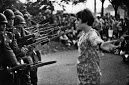
At demos, I remember standing opposite my peers, separated only by their helmets, flak vests, and bayonets. Electric storms flashed between soldier and protester. Boy soldiers who looked like my high school friends glared at us or avoided eye contact. We would shout, beg, and urge them to put down their arms and join us. A few did, but most stood grim, silent, aware of the baton-wielding U.S. Marshals standing behind them, keeping them in line.
If you stripped away the uniforms and class differences, they were us; we were them… only not.
The guardsmen who faced us had joined the reserves, to help pay for a college education, keep a job, to avoid combat status to stay with their growing families. During times of civil strive — including our massive march on the Pentagon when we levitated the place in October, ’67 — our working-class contemporaries were called upon to protect the national welfare from our commie-manipulated assaults.
Most of those guys didn’t want to be there, but once you joined the reserves, if the National Guard needed you, you went… unless you knew better.
I knew better. What a privilege.
Being a radical in the 1960s was not just about sex, drugs, or rock n’ roll, although there was plenty of that. The Movement could be terrifying, frustrating, and exhausting, but it was a joy and a privilege to live amid such intensity, passion, ingenuity, and joy. Why privilege? Because, even in the midst of weirdness and chaos, I knew what was happening. Or so I thought.
Truth be told, I didn’t understand how the disparities of class and culture played out until I graduated. The comfortable umbrella of my student–exempt draft status dissolved and zoom! I was out there.
I knew I would never fight. They could put me in jail or I’d split for Canada. One, two, three four, I won’t fight your dirty war.
Despite my boisterous resolve, I didn’t want to go to jail and I didn’t want to split for Canada. But the great river of class, culture and convictions afforded me a way out. I would become a 1-O, a conscientious objector.
In 1967, few Americans knew what a conscientious objector was. Selective Service defined it as “a firm, fixed, and sincere objection to participation in war by reason of religious training or belief.”
All I had to do was go up before my local draft board in leafy-green, upper crust Groton, Massachusetts and prove the sincerity of my objection. I wrote up my argument and appeared one late May evening at the New England town hall where the Selective Service board kept its chopping block and cleaver.
Trembling with anxiety, I walked into the musty, austere chamber. Portraits of bewigged and bewhiskered town fathers frowned down from the dark paneling. Late afternoon light filtered through high windows.
Beyond double doors, a carpeted aisle catapulted me toward the tribunal, seated on a raised dais. There they sat, my local draft board, three straight-nosed, ruddy Yankees, confident in their integrity, corseted by Brooks Brothers blazers punctuated by bow ties.
A grandfather clock ticked solemnly in the foyer. I felt like Kafka. But beneath my terror, a quiet voice counseled me — Brooks Brothers, bow ties = boys’ club.
There was no introductory chitchat. I was identified by name and purpose. An age-spotted hand signaled me to get on with it.
“War is a serious matter,” I began, voice quivering, “with bitter consequences for both the victor and the van…”
“The what? What’s that?” A Brooks Brother cupped a hand to his ear.
Oh wow, I thought. This guy is deaf. By the time I finished hollering for peace, my voice had stopped quivering but my speech notes rattled like the tail on a diamondback rattler.
I stood before the Brothers Brooks, sweat soaking my collar, mouth full of cigar ash. Under my sport coat, armpits ran rivers. I waited.
The tribunal never left the room. Whistling softly, a crew cut gent with a bowtie leafed through my selective service record. “Just graduated, eh?”
“Yessir.”
“Harvard, right? What house?”
Damn, I thought. I’m trying to make a life-and-death point here. I’d poured my soul into this argument. I’d drawn on every ounce of education, experience, and youthful conviction. I’d invoked Thoreau, Emerson, Mahatma Gandhi, Wilfred Owen, the young British poet who’d been killed in WW I, a week before Armistice was signed. I’d set out to convince these guys that war is not only hell, but useless and immoral, and they wanted to know what Harvard house I lived in? Damn.
I began to feel light-headed. The bloody mary I’d chugged earlier to calm my nerves threatened to come up.
The Brooks Brothers leaned in, blue-blazered shoulders hunched, and began to mutter. Finally, they straightened up, folded their hands, and looked down upon me.
“Well, young man, I’m not sure I catch your drift, but…”
“Walden Pond eh? Used to fish out that way.”
“Concord River too… What house was that? I was in Kirkland.”
All right already, I screamed inside. What’s the verdict here?
“We’ve decided to grant you status as a conscientious objector. You will need to register with the clerk in the morning.”
“Don’t he have to do community service?”
“I’m sure he’ll find something suitable.”
Hell yeah, I thought. I’ll find something suitable. I was headed to San Francisco to join a radical theater troupe. Community service that, old guys. But on that night, I was one of them.
The rest was a blur. I felt hollow. Limbs buzzing with fatigue and the release of adrenaline I stumbled down the courthouse steps and drove the familiar Groton roads in the soft light of a near-solstice evening. I passed kids in junk convertibles, young farmers in pickups, guys with no place to go.
I realized that, because of what I knew, I would not be going to Vietnam. One of these guys would take my place. Some of my high school buddies had already gone. I’d lost track of them, but they were over there, and their little brothers were about to follow. No wonder I felt hollow.
In the warm May evening, a great injustice had been done. I vowed to rail against the inequity of my acquittal and right the wrongs of war, regardless of cost. I embarked on my predetermined plan: return to San Francisco and overthrow the government of the United States through theater, music, and film. And with a little help from my friends, we damn near did.
# # #
I set Gates of Eden in the civil rights and anti-war movements of the 1960s. The first novel in my “resistance series,” Gates is published by Harvard Square Editions.
Camp was a strict place and we were not supposed to fraternize with the staff, but my best friend and I were fascinated by Donn. 1969 was the second summer that he and his sister had come to work as part of the back-stage theater crew, she on costumes, he on scenery. They were several years older than we were. Donn had tussled hair and a great overbite. He looked a bit like Mick Jagger and he liked to hang around with Val and me, though the expression “Camp frowns” clearly was in play here. We didn’t know it, but he was also a stoner…very much frowned on by the powers that be at Camp. Two weeks into the eight week summer, Donn was fired for “dealing pot”. In fact, he had purchased it from one of our theater compatriots. Val and I begged for leniency but it was too late and he was sent packing. He and I said our goodbyes in the wings of the theater with a long, lush kiss. He remarked, “Our goodbye would have been a nice hello”. Indeed.
He promised to write and I’ve always been a diligent correspondent. So we wrote to one another and I learned that very shortly after he returned home, he was shipped off to Vietnam. He never wrote about combat (thinking back, I suppose that would have been censored). He wrote about being stoned all the time, the heat and boredom, and wanting to return home. Once he included a cartoon. It showed a man undergoing a physical exam in a doctor’s office. The man had his pants down, the doctor examined his penis. The caption read, “You’re right it DOES look like Nixon’s nose!” Eventually the correspondence stopped. I never heard from him again.