
Close analysis of a close call


Close calls can be close only because of a chance occurrence, thought, or action. Like the so-called “Butterfly Effect” they often yield their own legacy, and in my father’s case, raise questions in my mind as to luck, responsibility, and personal values.

When I was a young teen, my father related, as best I recall, the following:

It was on St. Patrick’s Day 1953, in the middle of the Cold War, when a squadron of eight RB-36H’s left the runway in the Azores Islands, heading home to South Dakota for what promised to be a grueling 20+ hour flight strapped into uncomfortable seats in nasty weather. A circular storm system rotating clockwise promised a 100-knot headwind that would delay the return even more. The RB-36H was a specially modified B-36, a six propeller, four jet behemoth dreamed up by General “Bombs Away” Curtis Lemay, designed to penetrate Soviet Airspace to take photographs in “peacetime” and to drop a single nuclear bomb should war break out. Each plane had a crew of 23 servicemen.

This was more than a training mission, as the squadron was also testing whether they could sneak into the United States on the return trip without being picked up by US radar, intercepted radio communications, or visual observation. The plan was to fly close to the surface of the Atlantic and gain altitude only after entering US airspace. The crews were told not to use their radar, and to make no in-flight radio transmissions. Entry into North America was over Newfoundland, Canada.

Sitting in the co-pilot’s seat of the lead airplane was Brigadier General Richard Ellsworth, the officer in command of Rapid City Air Force Base in South Dakota. As the base commander, he didn’t have sufficient recent hours and training to be in command of the plane. He was basically along for the ride.

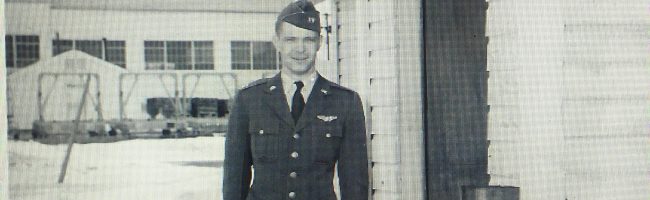
My father, then a First Lieutenant, was a navigator in one of the other planes. It was his responsibility to know where the plane was, and to tell the pilot where to fly to get back home. The flight left in the early daylight hours in the Azores, and flew through the night over the Atlantic. It was difficult to see the water below, and, with the cloud cover, virtually impossible to see any stars above. Sometime before dawn, he and the pilot agreed to gain altitude, violating the ground rules of the mission, to take a peek at the stars above the clouds, thereby allowing my father, trained in celestial navigation and armed with an Omega watch, to determine where they were. I don’t know who made the suggestion, but the information it produced was startling – they were over a hundred miles closer to land than expected. It turned out that over the night, the storm had migrated north. Rather than facing a headwind at the northern edge of this circular storm, they were at the southern edge. No longer hindered by the wind, they were instead pushed along at a rate far faster than anticipated. Armed with this information, the pilot gained altitude when new calculations indicated he would be approaching the edge of North America.

It turns out that the decision to take a peek and violate orders was, according to my father, followed by each of the other crews on this mission. (Other accounts said that some crews were able to see the stars through a break in the clouds.) At any rate, it is clear that the crew of the Commanding General’s plane stuck to the orders. At about 4:40 a.m., in a blinding rainstorm, it ran into a 900 foot hill at an altitude of 800 feet twenty miles inland from the Atlantic coast in Newfoundland. Everyone aboard was killed in what witnesses described as a tremendous fireball. The Air Force sent up another plane, a B-50 (the successor to the B-29 that dropped the atomic bombs in 1945) to search for the RB-36. It, too, crashed for unknown reasons, and was never recovered.

Families waiting for the crews got word of sketchy news reports of a crash involving an as-yet unidentified USAF plane. My mother, like other wives, called the Base. No information was forthcoming, and, no doubt, the person in the base command building had very little to give. Probably breaking protocol, and after pleading by my mother, he said that the Lieutenant had checked in. Our family did not escape unharmed, however. My grandmother, who also heard radio reports, was certain that my father had perished, and suffered a non-fatal heart attack which left her out of breath for the rest of her life. She had survived being struck by lightning and being bitten by a rattlesnake, so it would take more than a heart attack to take her down.

Soon thereafter, in a ceremony attended by President Eisenhower, Rapid City Air Force Base was rededicated as Ellsworth Air Force Base.

What strikes me, 67 years later, is the lesson my father imparted to me after telling this story – don’t obey a stupid order. It may end up killing you. To my father, at least, this mission was a close call. To others, of course, it wasn’t.

But other questions remain. Did my father accurately state the facts?  And do I remember accurately what he told me? And more haunting is a question raised years later by my twin brother (the good twin), and a question that never occurred to me (the evil twin) – did my father, or any of the other crews, who discovered their location only by violating orders, have any responsibility to break radio silence to alert other crews who might not have made the same navigational discovery?

Cooking with Gas

Cooking with Gas

“Now you’re cooking with gas.”,   my grandmother used to say.  I thought of her after Hurricane Sandy hit New York on October 29, 2012.

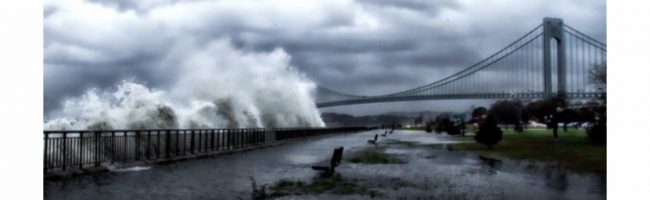
Although we live uptown,  our proximity to the East River puts our apartment building in the city’s infamous flood zone A.  When Sandy made landfall that day,  rain and river water surged down a ramp and flooded our building’s basement,  the force ripping an oil tank from the wall.  The tank crashed on the cement floor and split,  and the toxic mix of water,  oil, and raw sewage made the building unsafe.  We were all evacuated.

My husband and I moved three blocks north to the Marriott Hotel on E 92nd Street,  and from our room we could actually see our building and some of our own apartment windows.  And from that hotel room a few days later we watched the election returns and cheered as Barack Obama defeated Mitt Romney for his second term.

At first our apartment building had no electricity,  no heat,  no working elevators,  no water,  plumbing or phones,  but gradually most services were restored,  and so after two weeks at the Marriott,  we moved back home.  The only thing we still didn’t have was cooking gas,  but our super said it would be back in a week.

On the appointed day I tried the stove – no gas.  “It’s just your apartment line,”   the super said,  “we’re working on it.”

But after another week of restaurant dinners and take-out,  I said to the super,  “To tell you the truth,  life without cooking gas suits me fine!”

”What do you mean?”.  he said,  “Your gas has been back since last week,  haven’t you been trying your stove?

I had to confess I hadn’t.

“Don’t tell my husband.”   I told the super.

– Dana Susan Lehrman 

Story of the (Almost) Lost Child*

We went to Paris and Israel in 1984, the year our son turned thirteen. It was a wonderful trip marred by a few unforeseen catastrophes, the greatest of which was almost losing his little sister. Our daughters were ten and seven, and it was our youngest who gave me one of the most frightening close calls of my life. Under the supervision of six adults, she managed to disappear in the crowded market place of the Old City in Jerusalem. With us and then gone.

Allow me to back up a bit to several bad luck omens that foreshadowed the main event. A few days before we were due to depart for Paris, our youngest daughter came down with chicken pox. Her brother had never had it and her older sister had it a couple of years before. So, why now? The only French-speakers in our home were our two older kids, who refused to help us as we called the Paris hotel to explain we would be arriving later than our reservation date. After saying, “Hello oui,” back and forth for several minutes, my husband was somehow able to explain we would be checking in several days later than planned. Amazingly, we were also able to change our flight to Paris without much fuss.

We were sure she had recovered from chicken pox, but on the way to the airport she vomited in the car. Undeterred because she was often car sick, and now we only had three days to see all of Paris, we boarded the plane. I had the privilege of sitting next to her as she vomited during most of the flight. Once in Paris, she declared she felt better and we ran from one sight to another, trying to do the grand tour in three days. I think we spent a total of an hour rushing through the Louvre, seeing the Mona Lisa and Winged Victory. At any rate, the kids were satisfied that they had seen Paris, and we met my parents in Israel for the rest of the trip.

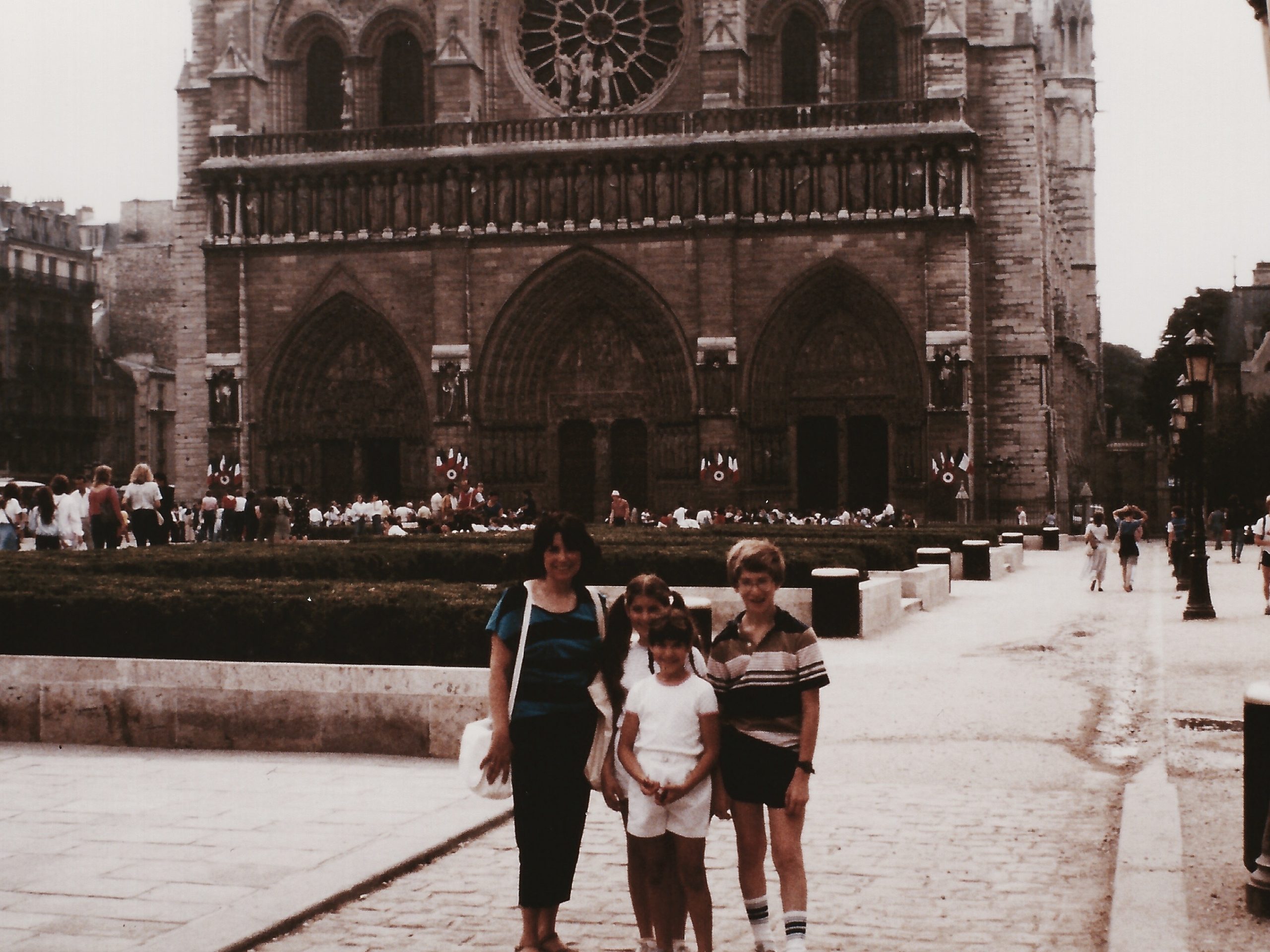
Proof we were in Paris

My father’s sister and her family lived on Kibbutz Ein Dor, where we all stayed. Every child there seemed to have chicken pox but they ran freely, played, and swam together. One of the pluses of communal living. On the down side, our middle child, who was immune to the pox, picked up a nasty intestinal virus there. No problem. She had what everyone was having, a painful antibiotic shot in her butt. After suffering this indignity, she was no longer a huge fan of kibbutz life.

My uncle drove all of us to Jerusalem to take in the sights and shop for a tallit for our son’s upcoming bar mitzvah. There were nine of us, but somehow, we crammed into a large vehicle for the trip. In the old city of Jerusalem, we wandered down crowded pathways looking for a shop my aunt recommended. My parents and uncle were bringing up the rear of our procession and, I assumed, watching my youngest daughter. When my aunt turned left to go down a side path into the store, we all followed. But apparently, everyone was so busy talking that it was only when I screamed in a panic, “Where’s Dana,” that the awful truth dawned on us. Busy socializing, her guardians didn’t notice that she kept walking straight ahead when everyone else turned left.

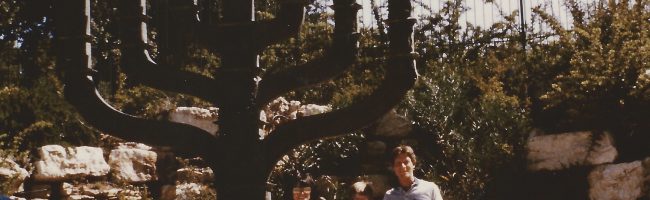
Our tour group minus my uncle and father, who were taking pictures

This was a disaster of Home Alone proportions. She didn’t speak the language or know where we were staying. I have no idea if she realized she was lost until I ran down the street screaming her name at the top of my lungs. At some point she heard me, stopped about a block from where I was, and burst into tears. I couldn’t believe my luck in finding her so quickly. If she hadn’t heard me or had turned down a different lane, or went with the proverbial evil stranger… I was shaken to my core.

I learned many lessons from this close call. I should have had a paper in her pocket with her name and contact information in Israel. I should have held her hand myself rather than assuming others would look out for her. I should have talked to all of my children about what to do if they became separated from us. I will never forget the panic I felt once I realized she was lost, and I am forever grateful that her ear was tuned to the sound of her mother screaming her name.

A happier moment prior to the lost episode

*My shout out to Elena Ferrante, whose Neapolitan Novels I adored.

I invite you to read my book Terribly Strange and Wonderfully Real and join my Facebook community.