...the house felt huge, empty and swept by onshore winds that buffeted the old frame building.
Read More
Beach Reads — Sankaty Head, Herman Melville, and the wreck of the Andrea Doria



...the house felt huge, empty and swept by onshore winds that buffeted the old frame building.
Read More

How did our prescient moderators know that the title of this week’s Book Review section of the New York Times would be “Beach Reads”?
Last November, my brother copied me on an email which shared the results of a 23andMe DNA analysis (since we have the same parents, we share the same DNA; yes, I know, we are not identical twins, so we do not have exactly the same DNA, but would have similar threads, so the results are similar for the two of us). We are of Eastern European extraction. Our paternal grandparents came to the US in the late 1800s from Kovno, Lithuania. Our maternal grandparents came from Bialystock, Lithuania in 1906 (we know more about them). So, not surprising, we are of Ashkenazic (Eastern European) descent. Indeed, 23andMe reported that we are 99.7% Ashkenazic (not quite as pure as Ivory Snow). We are 0.2% East Asian (0.1% unspecified Manchurian & Mongolian; my brother joked, “Let’s hear it for Ghengis Khan!”), and 0.1% broadly sub-Saharan African.
My brother is a college professor in Cincinnati. A colleague/friend in England helped him interpret the results; what various threads specifically meant. She wrote: “Rick, you’re a Canaanite!!! And your maternal line is one of four of the oldest maternal lines in the Ashkenazic community. These ancient paternal genes of the Canaanites passed from father to son for over 2,500 years. You are the first Canaanite I have ever met.”
Cool! Our genes rock! Does this mean I might be related to someone biblical? I feel kind of special, all of a sudden.
Another email arrived in May, not with DNA data, but details of our maternal grandparents trek from Russia to the US with two babies, again facilitated by a “genealogically-savvy” friend of my brother’s. My Stein grandfather (you can read about these grandparents in My Grandparents’ Story) was born in 1877 and Beila in 1878. There was a major pogrom in Bialystok between June 14 and 16, 1906. They left with their two babies soon thereafter, departing from Europe on July 22, 1906 on the S.S. New Amsterdam from the port of Rotterdam, and arrived in the port of New York on August 6, 1906 (my mother, though not yet born, was always proud that the family did not come steerage). He was almost 28, she was 27. My brother has the ship manifest, where they are listed as passengers 19-23. Ann was listed twice, once as Ann, once as Chana.
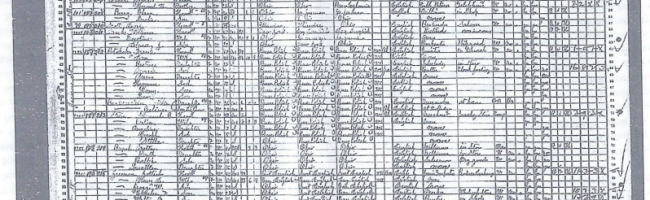
The Featured photo is the 1910 census. Think, for a moment, about all the turmoil going on thanks to our current administration, the up-coming 2020 census and the immigration crisis. How many of us would not be here if our grandparents, or some ancestors, had not been allowed to enter this country. What did it take in 1906 to become a citizen? My grandparents wrote and spoke heavily-accented English all their surviving days, but left a thriving business and quite nice investments for their heirs.
My Aunt Ann is listed as Angelina! She was never actually called that; wishful thinking on my grandmother’s part. My brother comments that the other two sisters were also given Classical Roman names: Stella and my mother, Cornelia (she detested that name and went by Connie). My brother also included the 1920 census (now Cornelia, born in 1913, makes an appearance) and a photo, from perhaps 1931 or ’32 including my grandfather, the four children; Ann, Joe, Stella and Connie and Ann’s husband, Lew Daniels in the upper right.
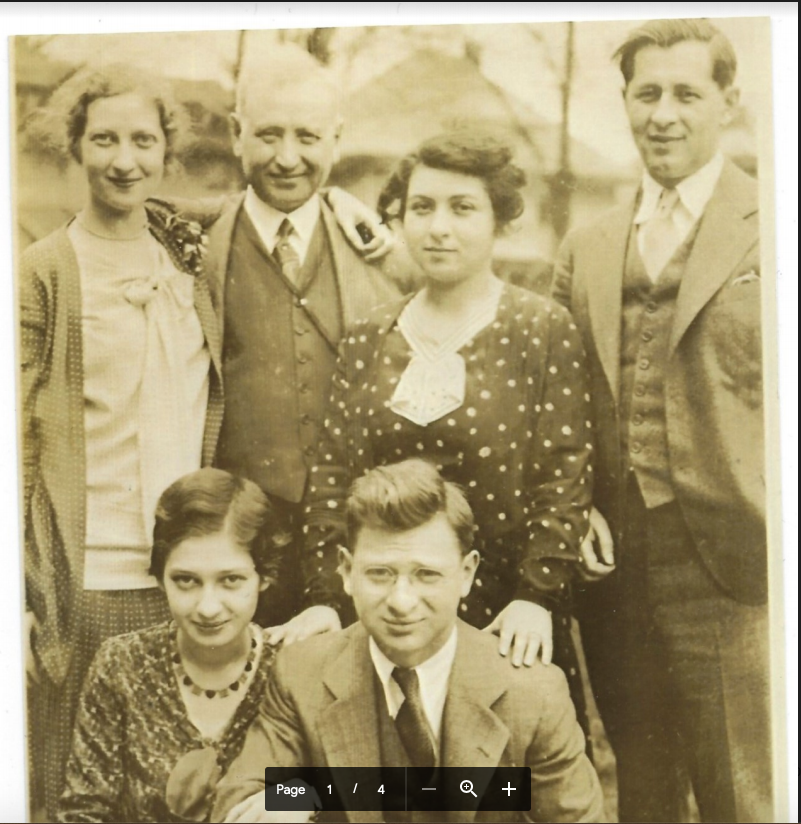
My grandparents joined Grandma’s mother in Toledo, OH, living in a two-flat with her. Grandpa had worked for a watchmaker in Russia and opened a successful jewelry store in Toledo. Joe joined him in the business, and after college and a year in New York, taking classes with Doris Humphrey and trying to make it in the dance world in 1935, my mother came home and worked as the store’s book keeper until WWII, when she went to Detroit, lived with Ann and Lew and worked for the USO. She met my father in February of 1946 and they married four months later. They were both 32 years old.
They began their lives together at that point. Rick followed in 1948 and I, the baby, completed the family in 1952.

I rarely go to the beach, and when I do, I am generally either working on my suntan (I know, very dangerous, but I still do it) or cooling off in the water. I can’t remember ever bringing a book to the beach either as a child or as an adult. But I do like the idea of a category of books called “beach reads,” suggesting that they are not too long and not too dense, so that you don’t have to be giving the book your full attention.
One of my favorite authors at any time of year is Jane Austen, but she only wrote six novels and I have read them all many times. It turns out though, that there is a whole industry of writing books that are either “what happens afterwards….” or a modern version of one of the novels. Over the years I have read way too many stories about what happens to Elizabeth Bennett and Mr. Darcy after Pride and Prejudice ends. Of course their marriage always survives, despite whatever problems the author decides to place in their path. I discovered these books just by browsing the shelves in the fiction section of the library. Some have been well-written and some not, but the fun is in seeing what they do with the characters I know so well. When these “afterwards” books became tiresome, I turned to the modernization category. Everyone probably knows the movie Clueless, which is an updated version of Emma that was very well done. There are many updated Austen books in the same vein. The book I just finished, The Three Weissmanns of Westport, is an improbably named modern version of Sense and Sensibility, which I stumbled on while looking for something else. It was good but not great, which may be the definition of a beach read. I might have ditched it halfway through, but I was curious to find out how the sisters in this book ended up and how closely it paralleled the fates of Austen’s characters.
For the past few years I have been in a book group, something I never thought I would do, until suddenly, in my sixties and retired from practicing law, it seemed like a good idea. We meet monthly year-round, and I’m not sure if the summer books are any lighter than the others, but they might be. The book I have just started, for next month’s meeting, is Finding Dorothy by Elizabeth Letts, which, while classified as fiction, tells the story behind the making of the movie The Wizard of Oz, highlighting the role played by L. Frank Baum’s widow in trying to keep the movie true to the spirit of the book. It looks like a fun read.
The book we just finished, and discussed at our July meeting, was Americanah by Chimamanda Ngozi Adiche, which I highly recommend. I see that Laurie has another book by this author as part of her featured image, so maybe I will look for that one when I’m finished with Dorothy. Everyone liked Americanah, so they may be receptive to reading more of this author when it is my turn to pick again. I love having this group of women to discuss books with. We don’t always agree, but we do have spirited discussions. Although the year that several of us had kids applying to college, we often ended up spending more time talking about the application process than the book of the month. And speaking of that, the last book that I chose was The Admissions by Meg Mitchell Moore, about a northern California family with lots of secrets, as well as a daughter applying to Harvard. So “admissions” refers to the things they have to admit to each other in the course of the book, as well as the college admissions process. It’s actually perfect summer reading, especially for anyone who went to Harvard, or applied there, or even thought of applying there.
Getting back to Jane Austen, in the process of writing this story, I have discovered a whole new trove of modern versions as well as continuations of her novels. I googled “modern takes on Jane Austen” and got over 17 million results! These are websites where people talk about their favorites, so I’m sure there is lots of duplication and there are certainly not 17 million books in this category. Nevertheless, I could clearly fill up the summer, or several summers, reading the ones that sound appealing to me.
This brings up another interesting discovery. My kids will shake their heads and say “oh, Mom…” if they ever read this, but it never occurred to me before that I could look for books on a certain topic online. Not to buy them online, but just to find out what is out there. I have long since given up buying books, because our bookshelves are full to overflowing and if I bought new books, I would have to give away some of my old treasures to make room. So for many years I have exclusively read books from the library, and have decided what to read based on what caught my eye on the shelves. Now I can start requesting some of these modern Jane Austen books and not have to depend on what I happen to see. Thank you Retrospect, for leading me to this revelation!