
Be True to Your School

Middle School. . . . In our day they called it Junior High School. I don’t know when the name was changed, or why, but in any event, I never went to one. My first school was a K-8, and my second school was a 7-12.

My town didn’t have a Junior High at that time. The elementary schools, of which there were nine, all went from kindergarten through 8th grade. My school was named Number Three School, because it had been the third one built. My older sisters went to Number Three, and then on to Belleville High School, the one and only high school in our town. While they were there, the quality of the high school plummeted. It was overcrowded, and eventually lost its accreditation. It also had more than its share of juvenile delinquents, or “hoods” as we called them. These hoods were of both genders. My middle sister once had a switchblade pulled on her in the girls’ bathroom. My parents, at the urging of my sisters, decided not to send me there.

So in sixth grade I took the admission test for a selective public high school called College High School, in Upper Montclair, a very WASPy town about 10 miles, and a cultural lifetime, away from my town. It was a six-year high school, going from seventh grade through twelfth. After passing a written test and an interview, I was admitted.

At Number Three School, I had been pretty popular. I had a friend group, and even a sort-of boyfriend. We had all known each other for years. I was sad to leave them all at the end of sixth grade. I was also mad that I got gypped out of a graduation, since that wouldn’t happen til eighth grade and I wouldn’t be there then. But I knew going to College High was the right thing to do, or maybe — come to think of it — I was never given a choice in the matter.

At College High, all the seventh graders were new, and they came from several different towns in the area. As a result, most were in the same boat I was, not knowing anyone before they got there. But there was a core group of about 6 or 7 from Montclair and Upper Montclair who did know each other, and it must have been a lot easier for them. Some, but not all. of these Montclair kids became the core of the popular crowd.

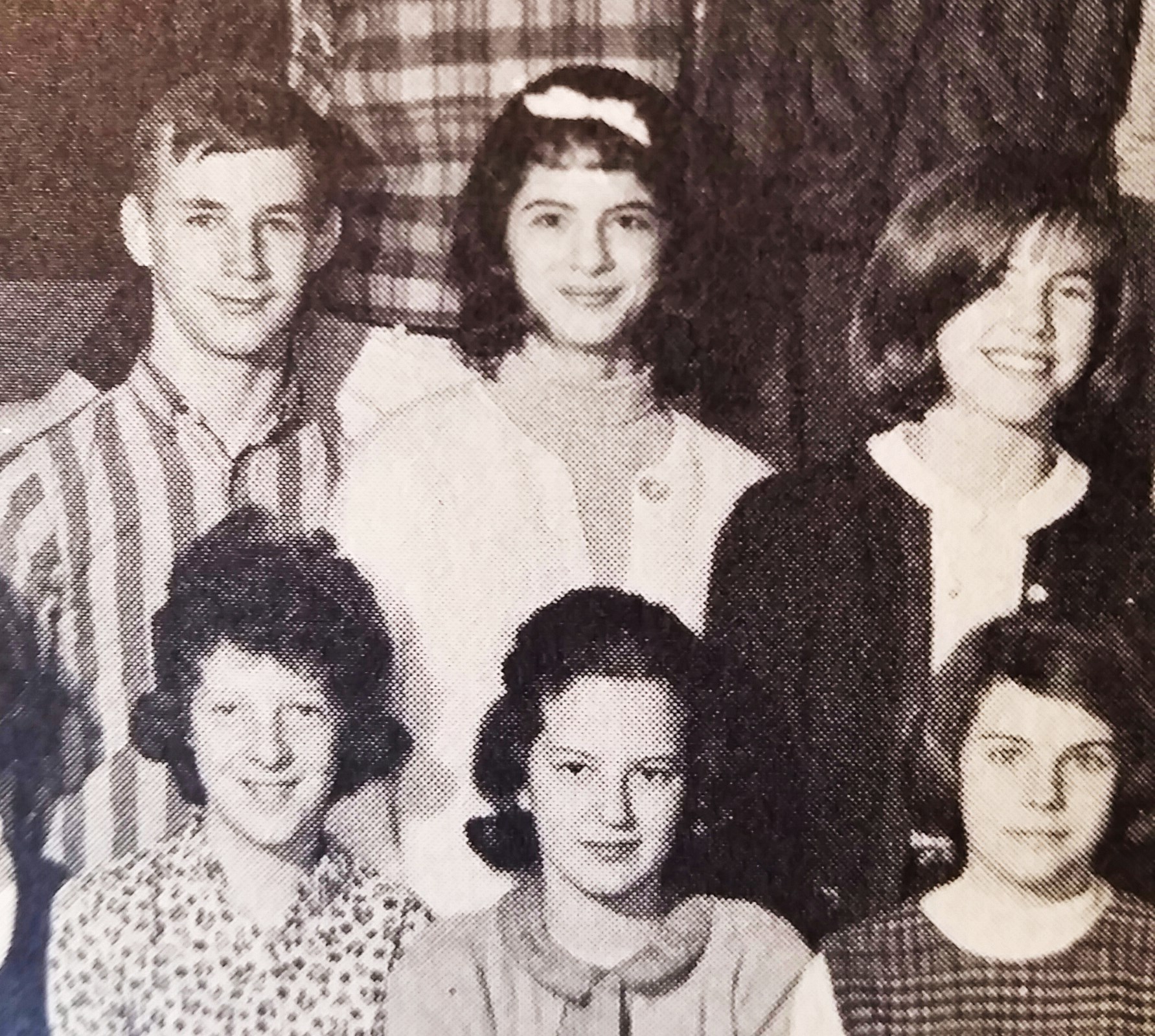
Everyone was friendly initially, as far as I can remember. But my town was very far behind Montclair in sophistication, and as a result so was I. As you can see from the portion of the class picture that I have used for the Featured Image, I am wearing white bobby socks, while most of the girls in the class were already wearing stockings, or at least knee socks like the girls on either side of me in the picture.

Also, because I had skipped a grade, and my birthday is at the end of August, I had turned eleven less than a week before I started 7th grade. Everyone else was twelve, some were almost thirteen. That is a huge developmental gap at that age. I was fine academically, but socially it took me a while to catch up even enough to understand what people were talking about.

And then, the problem at such a small school (only thirty-one of us in the class, sixteen girls and fifteen boys) was that the impression you made at the beginning tended to stick with you for the entire six years. There were a couple of exceptions, girls who started out mousy and unpopular who later became school royalty. But this generally involved winning the genetic lottery and developing large breasts, plus having straight hair and a complexion that worked with bleaching it platinum blonde. I had none of these attributes, so as hard as I tried to get into the popular crowd, I was doomed.

I don’t think of any of them as mean girls, like the ones in the movie of the same name. The popular girls were never mean to me. In fact, in one-on-one conversations, they were very friendly and nice. I would often talk on the phone with one or another of them, or hang out together sometimes. It was just when they all got together, there wasn’t room for me.

Actually I suffered more from being ignored by the boys. I went to all the school dances, and kept hoping that someone would ask me to dance, but nobody ever did. So I danced the fast dances with other girls, and then went back to the wall (yes, a veritable wallflower) during the slow ones. I don’t know why I didn’t stop going, but I guess I kept hoping that magically things would change.

I wore glasses (although never in pictures), and got braces during seventh grade, which didn’t help matters. When the braces came off in the middle of ninth grade, that actually was a magical change. A couple of boys in older classes started noticing me and my radiant smile, but by that time it was too late to affect the opinion of boys in my own class.

The Beach Boys song “Be True to Your School” came out in October 1963, the fall of my 8th grade year. The principal made the DJs play it over and over at school dances, to emphasize the importance of school spirit. One thing everyone could agree on was how sick we got of that song! I like it now, but it always reminds me of those painful College High dances.

To complete the story, here I am in my eighth grade class picture. I had moved on from headbands to hairbows. I have the closed-mouth smile of a braces wearer. Now I can see that I was kind of cute, but I sure didn’t think so then! It took me until college to become confident in myself socially, because College High, starting in seventh grade, had convinced me that I was undesirable.
 

# # #

Op Tails

I went to work for Management Decision Systems in May of 1981. It was a young, vibrant company founded by John D. C. Little and Glen Urban of MIT Sloan School, Len Lodish of Wharton and two of their brightest students, Jay Wurts and Rick Karash, to do marketing models. It expanded to do all sorts of decision support systems, financial as well as marketing models and sell the proprietary software they developed to support their unique mutl-dimensional modeling approach. I was their new sales representative. Though not versed in their software or systems, they knew I was bright, tenacious, could present in front of high level professionals and had excellent follow through. I could always bring a technical person along to demonstrate the product. It was a long, consultative sales process.

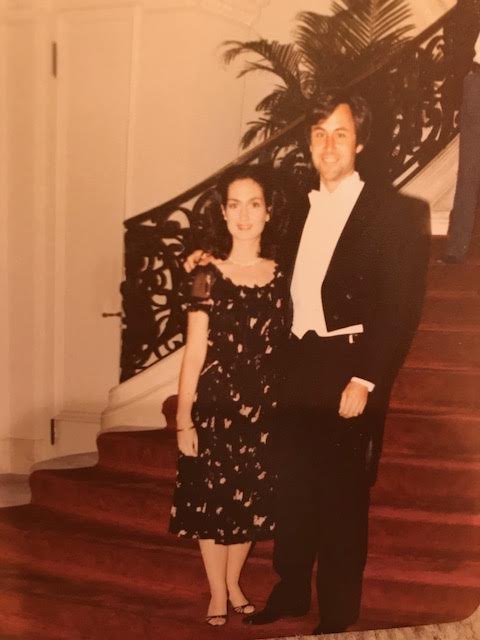
One week after I started on the new job, my husband’s company, Index Systems, Inc, also founded by smart MIT people, in particular, president Tom Gerrity, a decision support systems guru, held a two-day seminar in Newport, RI for their consultants and top clients with a white tie dinner dance at Rosecliff Mansion on the night in between the two days. It was called Op Tails because some time earlier, they held a company team-buliding sailing event dubbed Op Sail.

Spouses were invited to the dinner party. Rosecliff has the largest ballroom of all the Gilded Age mansions along Bellevue Ave and was the spot where the fabulous party scene from the Robert Redford/Mia Farrow “Great Gatsby” movie was shot. You bet I wanted to be there.

Dan’s white tie and tails were rented for him by the company, but I had to buy an appropriate dress. I looked at Bloomingdale’s. I would not buy a gown, but thought a cocktail dress would do and found an Albert Nippon appropriate for the occasion, my figure and budget. It still resides in a basement wardrobe. I convinced my new company that I would learn a lot from a lecture about Decision Support from Tom Gerrity and drove down the afternoon before the party, windows down to let the breeze give my body wave more volume.

Dan and I were giddy as we dressed in the hotel where the conference was held, then drove together to the grounds of Rosecliff. Everything was magnificent. The company had hired a photographer to take our photograph outside the mansion in front of a  classic and still-functioning 1925 Rolls Royce Phantom. We took turns being driven in it up and down Bellevue Ave. We felt like something out of a by-gone era society event. Everyone looked fantastic. One friend wore a long black dress with elbow length white gloves. Her partner (now husband) had a silk top hat, cape and cane. We thought they were the most glamorous couple at the ball.

We took photos of ourselves on the famous heart-shaped stair case, where a century earlier, debutantes made a grand entrance.We thought we were quite stunning too.

Dinner was served outside, in the formal gardens, overlooking a reflecting pool. Later we came in for dancing to a live orchestra. No detail was spared. It was an enchanted evening.

The next day, I did attend Tom’s seminar about decision support systems and to my delight and eternal gratitude, I learned much useful about the topic that would be the basis of my sales knowledge for many years to come. Tom went on to become the Dean of Wharton Business School. For a period, I was the top sales person at MDS. Though I left after 3 1/2 years, I stay in touch with many of my colleagues there and still consider it the best work experience of my life. I believe taking the day (and evening) off to listen to Tom Gerrity (and attend an out-of-this world) party, was a great way to start on the right path to succeed at my new job.

Painful Still

The memories are still painful. A close friend once wished I could have a selective lobotomy to block them out. My family moved from Detroit to a near suburb when I was just shy of 11. In Detroit, if your birthday fell between December 1 and the end of February, you started school in the middle of the year, after the February break and would always be half-way though a grade at the end of the school year. Most people went to summer school before entering high school to make up the time. I moved while half-way through 5th grade. I was smart and tested well above grade level, so I was tutored for four weeks over the summer in math and plunked into 6th grade in the fall of 1963. I felt like an alien.

Though the academics were easy (and that, in and of itself, was a problem; no one liked a smart, young, gawky kid), socially I was a misfit, entering a school that was K-6, as a 6th grader. Everyone else had been together forever and the mothers all knew one another from their clubs and social gatherings. I barely survived. The school even provided me with a counselor who told me I would be fine. In that moment it didn’t help. I was skeptical. The music teacher had me sing a solo during the Christmas pageant to let me show off my talent. The teachers really tried. I was socially inept and my mother could not lead the way nor smooth my path.

The next year, along with kids from other feeder elementary schools, I entered Clara Barton Junior High School. I had a bad hair cut, buck teeth, wore those terrible cat’s eye glasses (always removed for photos). I was a mess. It didn’t help that I was smart. Brains and being sensitive were not valuable assets. Having a large wardrobe scored points. Belonging to the right country club, having a good tennis swing. That’s what counted. Sounds shallow, right? But that’s what it was all about. This was mean girl territory.

I got into braces and even wore my headgear during lunch period, after eating. I wanted to get things moving in the right direction as quickly as I could. I was shamed into wearing a bra at the end of 6th grade, though my mother swore I only had little “mosquito bites”. As I mentioned, she was not helpful. I had very few friends. I was almost toxic. I was painfully shy. I loved acting. It took me out of myself and I could try on different personas, but the school had no drama department or other outlet for acting. I was in the GIrl’s Glee Club. Kids made fun of me behind my back.

Getting to the National Music Camp in northern Michigan every summer (I started in 1964, after 6th grade) was my salvation. There I met others like me, and made friends of a lifetime. I could freely express my artistic loves; singing, acting, dancing; and not be embarrassed. On the other hand, growing up near Motown, I did learn to dance! I mean to rock and roll, soul, you name it. When I got to college, I had guys lined up to watch me, but I danced like all the girls I went to school with. We practiced during Home Ec while our food cooked.

8th grade was a slight improvement. I finally made a few good friends. One remains my friend to this day. I started letting my hair grow. It took a few years, but things got better (and I got contact lenses). By the end of 8th grade, I got out of braces, and was only wearing a retainer (which looked like an NFL mouth guard). If life seems swallowed up by shallow musings, it is difficult to concentrate on other things when you are miserable, when you are isolated, when kids mock you, when you feel alone. To this day, I identify with those stories on TV about kids who are cyber-bullied, or picked on relentlessly. I have a visceral reaction to the ugly name-calling from our Bully-in-Chief.

Class work was never a problem for me. I was always a straight “A” student. In fact, that put off some kids. Being awkward and smart was a problem. A year later, I learned to hide the fact that I was smart. Boys didn’t like smart girls (talk about buying into a stupid role model, but this was the mid-60s and being popular seemed important; or at least, I longed to be liked).

A few years later, someone I knew from middle school told me she had thought I was an awful snob back then. I was flabbergasted and told her so. I told her I was SO shy, I had been afraid of my own shadow. Slowly, I learned to talk to others, how to converse about things besides art or music…to broaden my frame of reference. I learned that looks didn’t matter so much, and where you came from didn’t matter at all. What you stood for, what you thought about, what kind of person you were; that’s what mattered. I went to all the sporting events at my high school and loved them. I found my group and did things I enjoyed. It took three years, but I came out of my shell and I was OK. I am grateful I didn’t live in a time of cyberbullying. That must be truly terrifying.

The kids of the world need empathy. Being on the computer all day does not teach it. MIT professors fear for this generation. They need to put down their devices, look one another in the eyes and talk to one another, not tweet at each other, or think that having loads of Instagram followers will make them popular. Having the right clothes means nothing if your head is empty. Get out of your bubble and meet people, talk (don’t shout) to one another. Listen, exchange ideas. No eye-rolling allowed. Learn respect. Learn about differences. Learn to tell the truth. Learn what the truth is.