

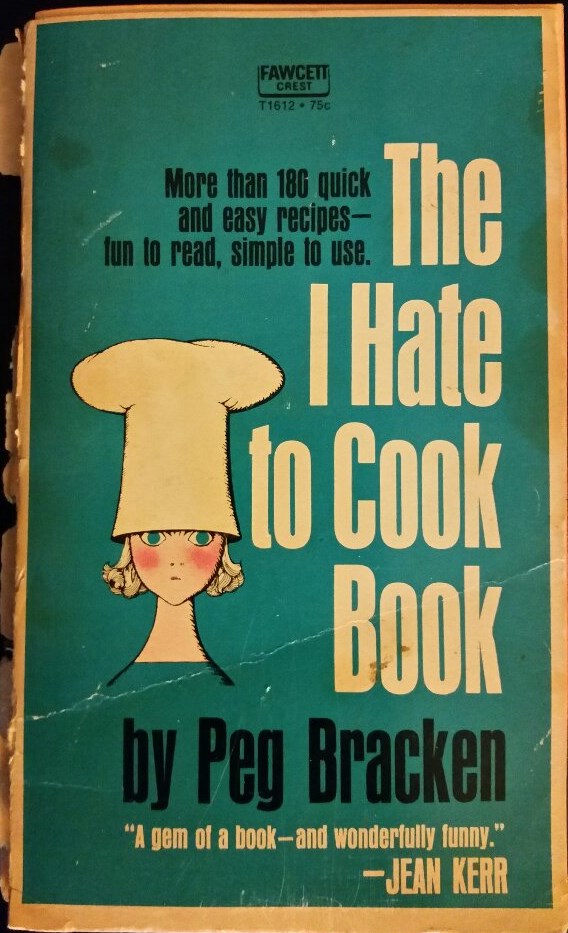
The I Hate to Cook Book

image-1879567997

My mother was not much of a cook. She made dinner every night for 30 years (except for the occasional restaurant meal), and then, when my father retired and the kids were all grown up and gone, she never cooked again. She certainly never imbued any of her three daughters with a love of cooking, although we have each come to enjoy it to varying degrees.

A few months after I graduated from college, I went to work for the US Department of Transportation, and moved into a wonderful big old house in Inman Square, Cambridge. To celebrate my first venture at living on my own, my mother gave me two cookbooks. The first, a large hardcover book, was The Joy of Cooking by Irma Rombauer. This has been a classic for generations. My mother had received an earlier edition of it as a bride in 1943, which had a whole section about dealing with wartime rationing. It had gone through numerous revisions since that time. In a parody of Happy Hanukkah and Merry Christmas, she had inscribed it “Happy Homemaking and Merry Cooking! from December 1972 on, whenever you’re in the mood.” This book has been surprisingly useful over the years, and I still consult it from time to time.

The second cookbook was The I Hate to Cook Book by Peg Bracken. This book was written in 1960, when of course women had to cook all the time whether they liked it or not. It is full of easy recipes, with humorous commentary sprinkled generously throughout. (It also has wonderful illustrations by Hilary Knight, the same artist who illustrated the Eloise books.) I actually made many of the dishes in the book during my early years on my own. Once I got into more sophisticated recipes that didn’t involve using things out of cans, I stopped looking at it. But I never got rid of it. Recently, for some reason, I was talking to my kids about this book, and pulled it off the cookbook shelf in the kitchen to show it to them. It automatically opened to the page that had been one of my favorites, a beef stroganoff recipe. We all cracked up as I read it aloud. After the first two sentences, involving cooking the noodles and browning the beef, the third sentence was as follows:

“Add the flour, salt, paprika, and mushrooms, stir, and let it cook five minutes while you light a cigarette and stare sullenly at the sink.”

While this seems hilariously funny now, I shudder to think how many ’60s housewives, probably including my mother, did exactly that when they were cooking. We really have come a long way, in so many respects!
 

A culinary endurance story

7e7ba016b9e1c27e6ce1e0052c1e123a

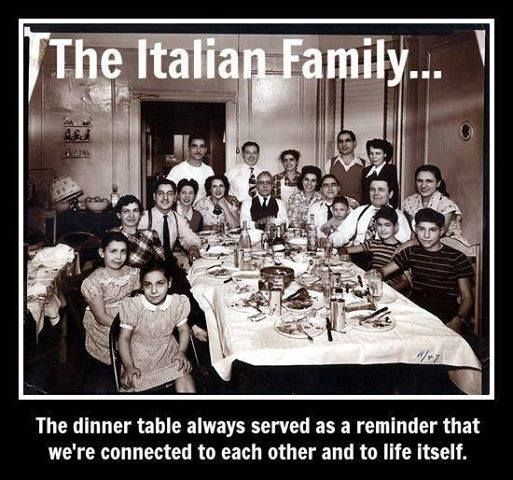
Being from an Italian Family was well…… a culinary journey and a eating endurance contest.

I grew up in a what was called as tenament in Fall River, Massachusetts.  If you do not know what that is, it is simply a duplex stacked one on the other.  We lived above my grandparents until I was around 7 years old.   I recall holidays as a  eat non-stop eating.   We would start at the table with a 5 course meal that lasted for hours on end.   And you were not excused from the table until the 5th course was finished. Naturally we had antipasti, pasta, soup before the entree arrived.  This was a typical Italian Thanksgiving, where the bird was not always front and center.

I lived upstairs.  In those days we had a ice box, with real block ice, a milkman and a bakery delivery.  One might think that was a luxury in todays terms.  Other than the icebox – I suppose it was.  Preparing for the holidays was quite an event,  I would come home from school, bolt up the back staircase, as the front staircase was off limits for me and was only used for company.  I would always  stop in to see what Grandma was cooking on my way up.   Normally she would be making pasta, rolling it out gently on her ironing board.  Did I say ironing board?  We all know what that is – right?  She would then gingerly transfer the freshly made pasta to a drying rack in preparation for a holiday meal.  Tomato  sauce with homemade Italian sausage was simmering with meatballs on the old stove.   This is a recipe I still maintain today, despite the preponderance  of jarred sauces that are available.

Dinner started at around 11:00 in the morning.   As a family,  we would stay  at the table for at least 3 to 4 hours as if glued to our chairs.  My Grandpa would kick things off perched  at the head of  the table with his traditional “salute”  and a brandy in one hand.  We talked about days gone by and summers at the Rhode Island cottage.   One course followed another, each better than the first.  Can you imagine on Thanksgiving Day starting with salami, cheese, olives, bread and more.  Then came the pasta with sausage and meatballs.  Finally,  the turkey and fixings and then salad. But who had room?   We have not even got to dessert!   Gronk!   Finally dessert – or I should say desserts.  Grandma would make italian fried cookies coated with powdered sugar, cakes and other goodies.

After barely having the energy to move to the living room, we would then be entertained my Grandpa, who was amusing.  He loved Opera.  His vocal range was amazing.  He would don hats, both male and female and sing the parts from the famous Opera ”Pagliacci” (meaning “Clowns”) is an Italian opera in a prologue and two acts, with music and libretto by Ruggero Leoncavallo. It is the only Leoncavallo opera that is still widely performed. It is often staged by opera companies as a double bill with ”Cavalleria rusticana” by Mascagni, known as ”Cav and Pag”.  His talent along with his brandy made for a memorable completion to the feast in which the brandy and the wine went down the drain per Grandma.

I now understand why I was a “pudgy” kid.