My parents, who had thought it wonderful that I had grandpa Max's eyes, said it was unfortunate that I had his nose, too. Ah, well, I thought, that's the genetic roll of the dice.
Read More
Grandpa Max’s Nose
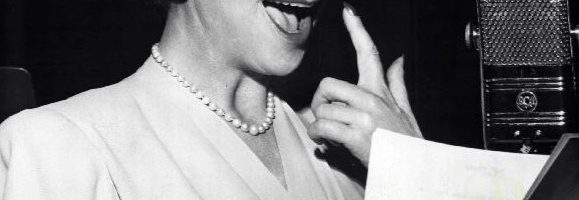



My parents, who had thought it wonderful that I had grandpa Max's eyes, said it was unfortunate that I had his nose, too. Ah, well, I thought, that's the genetic roll of the dice.
Read More

The story is about my father, who was born in 1909, got his bachelor's degree from Rutgers University in 1928 or '29, went to work as a pharmacist in the family drugstore, but wanted to be a doctor,
Read More
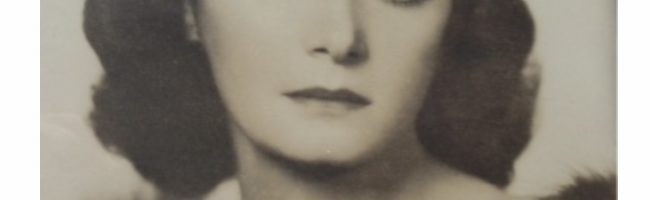
Aunt Miriam, Diva
My beautiful and glamorous great-aunt Miriam Elias lived a rather scandalous life, or so goes the family legend!
Miriam was born in 1897 near Kamenets Podolski, Ukraine in a small village near Odessa. Her village, she once told us, was very much like the fictional shtetl Anatevka immortalized in Fiddler on the Roof.
In fact her father was the village rabbi and like Tevya in Fiddler, he had five daughters. Miriam was the adored youngest of those five Elias sisters, and my paternal grandmother Esther was the eldest.
My grandmother Esther eventually ran a hotel in the Catskills, and for memories of summers spent at that hotel see My Game Mother, Hotel Kittens, My Heart Remembers My Grandmother’s Hotel, The Cat and the Forshpeiz, Our Special Guests, and Playing with Fire.
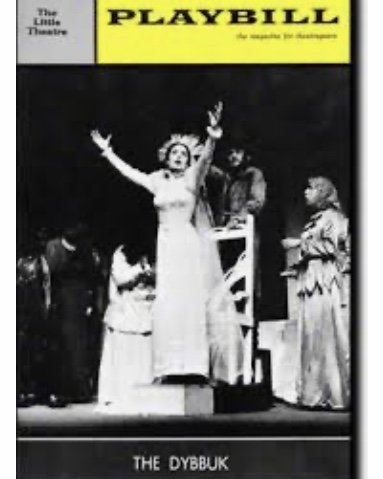
But in the Ukraine years earlier when my great-aunt Miriam was quite young her talent for singing and acting was evident and she began performing with a local Yiddish-speaking drama club. Later she joined a professional Russian troupe, and in 1916 at age 19 went to Moscow to join the Hebrew-language Habima Theatre where she first performed in the classic drama The Dybbuk. Miriam played the title role of Chanan, the poor male student whose spirit, or dybbuk, possesses the body of his beloved after his death.
Miriam also studied at the Moscow Art Theatre with the famous Russian director Konstantin Stanislavski, and in Moscow met and married a young artist named Boris Aronson.
In 1923 the couple moved to the States where Miriam toured with a Yiddish troupe, and Boris began designing sets for the theatre. Their young marriage ended in divorce, but Boris Aronson went on to great success winning 6 Tony awards and many nominations in set design for shows including Fiddler on the Roof, Cabaret, Zorba and Follies.
Throughout the 1930s and 40s Miriam acted regularly in theatre here and abroad, but by the 50s her career had peaked. She then settled in Far Rockaway living next door to her sister, my grandmother Esther, and near two other Elias sisters who had also emigrated. With no children of her own, she doted on her nieces and nephews, my father Arthur among them.
Miriam lived with uncle Meyer, a kind and rather portly older Russian gentleman who obviously adored her. Meyer was a candy importer, and I remember crystal candy dishes full of of halvah and other sweet treats in their living room, and a large grand piano holding dozens of photos of Miriam in her many stage roles.
Although I called him uncle, apparently Miriam and Meyer hadn’t been married, But when he became quite ill, they realized a marriage would avoid legal and financial complications after his death. At that time in New York State, blood tests called Wassermanns were required to detect syphilis.
The family story I’ve heard is that Meyer was too ill to have his blood drawn, so my physician-father drew Miriam’s blood and divided it into two vials!
And here’s another marriage story. Miriam’s niece Isabel was to be married to a young man named Bernie. An Orthodox rabbi was called in to perform the ceremony in her parents’ home with only the family attending. The rabbi began to recite – in Hebrew – the words that would make the couple man and wife, when supposedly Miriam cried out in Hebrew for the rabbi to stop!
The family spoke Russian and Yiddish, but only the Habima-trained Miriam was fluent in Hebrew, and only she realized that the rabbi was about to marry Isabelle not to her intended groom Bernie, but to her own brother Victor!
Over the years that close-knit Elias family dispersed as marriage and work took my father, his siblings and his cousins their separate ways. After the deaths of Meyer and eventually her three sisters, Miriam sold her Rockaway house and moved to Manhattan.
She was living on Central Park West when the big blackout plunged New York City into darkness on November 9, 1965. By chance that afternoon I was shopping in mid-town with my friend Stephanie. (For a sweet memory of that friendship see Postcards from a Secret Admirer.)
Both of us were in graduate school at the time, and Stephanie was living up in the Bronx, and I up at Columbia. But the city was in chaos, the trains and buses weren’t running, and we knew that neither of us could get home that night.
The phone lines were out and of course there were no cell phones back then, but I assumed that my aunt Miriam would be at home, so Stephanie and I walked to her building. Once there we found that neither the intercom nor the elevators were working, and so we climbed the stairs to Miriam’s apartment.
Delighted to see us, Miriam plied us with cake and tea, and then set several large candles out on her living room floor and regaled her two young visitors with stories of her life and career. She showed us scrapbooks full of clippings and photographs of my aunt with Stanislavski, Albert Einstein, the Indian writer and Nobel Laureate Rabindranath Tagore, and the great Russian artist Marc Chagall among others. All these men, according to family legend, had been Miriam’s lovers. How much was true, I guess we’ll never know!
Over the next few years Miriam did have occasional acting roles in New York’s Yiddish theatre. But when that ceased, and with age encroaching, she gave up her apartment and moved into the Barbizon Hotel on Lexington @ 60th Street, then an elegant residence for single women.
Busy with my own life – I was a working mom by then – I didn’t see Miriam very often although we both now lived in Manhattan. But I remember once we had plans to see a Broadway show together and I was to call up from the hotel lobby when I arrived to pick her up.
I had some chores to do in midtown beforehand and was done much sooner than I’d expected. I had a good book with me and rather than go home first, I decided to spend an hour waiting in the comfortable Barbizon lobby before ringing up to tell Miriam I was there.
But when I got to the Barbizon well before the appointed hour, Miriam was already downstairs waiting for me. Impeccably groomed as always and dressed in one of her long, dramatic capes, Miriam told me she had come down early to be sure we wouldn’t miss the curtain.
Passionate about theatre, Miriam certainly didn’t want to be late, but more was at play. My glamorous aunt, once a grand dame on the international stage, had out-lived sisters, husbands and lovers, and age had taken it’s toll on her beauty. Behind the carefully made-up face and the elegant clothing was a frail, elderly lady now living a somewhat lonely life. Our theatre plan, I realized, may have been her only outing for days.
I vowed to see Miriam more often and to listen more attentively to the stories of her journey from that small Ukrainian village to some of the world’s great theatres and concert halls. That I did, and after Miriam died I kept one of her beautiful capes.
Rest in peace my beloved diva, I’ll never forget you.
– Dana Susan Lehrman

I first wrote this story for the prompt “Finding Your Tribe” on March 14, 2020, just before the start of the pandemic, and added an addendum as Massachusetts shut down the next week, then came back last year. Our conductor, Rick Travers, starts every season (I joined this chorus 20 years ago) by saying the MOST important word in our title is COMMUNITY. We all have fun doing what we do. Though serious about our music, we are allowed to miss rehearsals without penalty (that is not true of many other choruses) and are encouraged to socialized. We wear name tags so everyone knows who we are. We are a welcoming group, we look out for one another. I just became a Board member last April. I always resisted because I am away during the summer, so cannot attend meetings, but they are now on Zoom, and we travel a fair amount, even during the year, but I will do what I can and aid in fundraising. We continued to pay our director and accompanist during our COVID break, so we need to replenish our coffers. We will work with the greater community to do that, as well as having a fun event at my home in mid-October – dessert and art tour, perhaps with some piano playing and singing for fun.
*****************************************************************************************************************************
As I wrote in Gotta Sing, I have loved to sing my whole life and did so in some fashion during my first 18 years of life. After marrying, going to work full-time, then having children, I no longer had opportunities, beyond the occasional lullaby or shower singing to exercise that love. I sang with a group from the Brandeis National Women’s Committee when my children were young, but that was short-lived, as our director passed away.
I own a beautiful piano and at least used to vocalize and sing for my own pleasure until my younger child howled in protest. I thought he was just giving me a difficult time until the diagnoses were slowly revealed, including Asperger’s Syndrome which included various forms of sensory integration issues. He, literally, couldn’t stand the timbre of my high-pitched voice, so I stopped singing in the house altogether. I missed singing.
In elementary school, David began taking piano lessons from a lovely woman in the neighborhood. She was kind and patient with her student charges and served them hot fudge Sundaes as a special treat, particularly after their June recitals. We became good friends, even inviting non-Jewish Nancy to our Passover seders. Here she is in 1999, though David no longer took lessons from her.
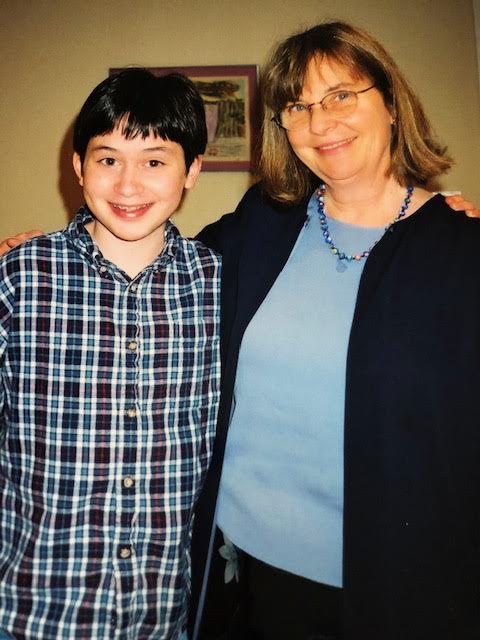
Nancy told me about a wonderful local chorus she sang with and she was sure I’d enjoy as well, but they rehearsed every Monday night. Dan traveled constantly and I couldn’t imaging finding a babysitter that consistently.
A year after Dan retired in 2002, I called Nancy for information. She invited me to come to the first rehearsal. They met at a local Catholic girl’s school, a few miles from my house and rehearsed every Monday night during the school year. She also told me there would be no auditions, which reassured me, since it had been YEARS since I had sung with any sort of organized group, or had to read a musical score. She gave me some background on the officers of the group (since the Newton Community Chorus is technically a non-profit) and the director, Rick Travers, who at the time, was the conductor of the top choirs at Newton North High School. He has since retired from the public school, but remains active performing (he is an accomplished jazz pianist) and conducting. Rick is patient but exacting with us and constantly teaching us.
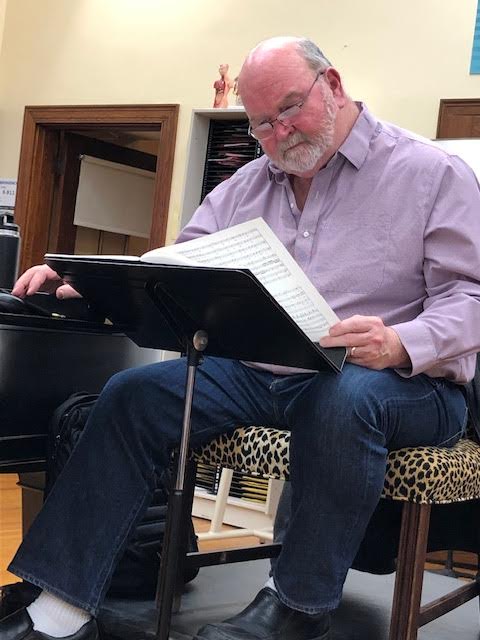
Rick at a recent rehearsal, listening to the basses.
I showed up that first Monday to learn we would be singing the Brahms German Requiem in German that semester, a difficult but gorgeous piece of music. And there WERE auditions! I was sort of freaked out. We spent that first rehearsal working on the fourth movement (in English: “How Lovely is They Dwelling Place”, which I had sung many times at camp years ago, but NEVER in German). Our audition would be a few measures from that movement. I was confident of the music but not the German. I received a call the next day from an officer welcoming me to the chorus. I was elated and have felt at home ever since.
We worked very hard on that particular work that semester. I easily made friends among my fellow sopranos. We didn’t have assigned seats, but tended to sit in the same spot every week, so chatted with the women on either side of me. Through the years, as the chorus has expanded and contracted, the two women on either side of me have remained constant and become dear to me, supports in times of sickness and joy.
We do all sorts of fundraising to support our chorus, as we pay for our director, rehearsal accompanist, professional soloists and full orchestra for our performances. We perform our piece once in the winter, then learn new music to perform in the spring. Our performance space is a local church.
The Brahms German Requiem went extremely well. I was buzzing with excitement for days after. I called my dear friend Patti the next day. I met Patti in Girl’s Choir in 10th grade. She and husband John (founders of MyRetrospect) had sung under the baton of Michael Tilson-Thomas with the San Francisco Orchestra for some serious concerts. (They have Grammy awards for Carmina Burana. I listened to their performance while practicing for my own performance many years ago.) She understood. I just wanted to talk about the experience, as she could relate. We talked for hours. It was like I had the proverbial “runner’s high”. I knew I was on to something important.
During my 16 years with the chorus, we have sung the Brahms German Requiem twice, the Mozart Requiem twice, both favorites of mine. We’ve done several sections of Handel’s Messiah, but long ago. Finally, last semester, we sang the Fauré Requiem, another long-time favorite. We’ve sung masses, requiems, oratorios (The Elijah, The Creation; glorious), more contemporary works; we are currently working on Stravinsky and Dovrak masses. Our group tends to be larger in the fall semester, as big as 90 voices (sometimes dependent on the music we are singing), then dip to perhaps 60 voices in the spring. Springtime seems to be a difficult time for lots of people, with weddings, graduations and the like, so fewer people can sing at that time of year. I will not be able to perform at this concert, due to a long-planned European trip, but am still going to rehearsals and learning the music, for the fun, camaraderie and to keep my brain alive.
A particular favorite work we sang, that is not among the well-known in the choral repretoire was Dona Nobis Pacem by Ralph Vaughn Williams.
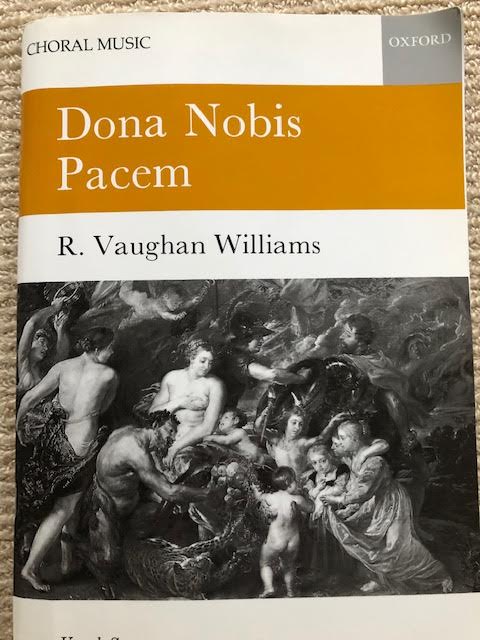
Vaughn Williams, a British composer, was deeply affected by his service during WWI. As he saw the storm clouds gathering over Europe in 1936, he wrote this cantata as an anti-war warning. It combines a bit of the Latin mass with poems by Walt Whitman from the Civil War, a bit of a sermon from a British anti-war minister and passages from the Old Testament. I found it incredibly moving when we performed it in 2007. I listened to the recording recently and found it still had the same impact (we do record our concerts and get CDs later). I am particularly moved by Movement IV, “Dirge For Two Veterans”, a Whitman poem about the burial of two soldiers, a dead father and son. The music sounds military with bugles blaring and the rat-a-tat of the drums, beating, louder and louder as the procession approaches to the new-made graves. “For the son is brought with the father…Two veterans, son and father, dropped together.” The music is percussive and stops on the words “dropped together” for added emphasis. The music dims as the procession marches on. The last words of the movement are; “My heart gives your love.” The chord does not resolve. It tore me apart to sing it.
February of 2007 had been a tough month in our household. I had rotator cuff surgery, with Jeffrey coughing and coughing. A day later he was diagnosed with pneumonia. Then I caught it. We both thought we were OK (though I had a long recovery from my surgery, as I developed a frozen shoulder and did months of PT), when suddenly, Jeffrey noticed a numbness in his left leg; within hours it crept up his trunk into his arm, then his face. I called his doctor who told us to take him to the ER STAT! I was still too sick to go, but Dan spent an excruciating 11 hours at Children’s Hospital while they ran test after test. They couldn’t find any explanation and finally sent him home and told us to wait. He lay in bed, frightened. I sat with him. He cried, “I got into Brown, early decision. Will I be able to go?” I tried to comfort him, attempting to hide my own anxiety. Eventually they thought he had some weird brain virus, triggered by the pneumonia, that resolved on its own.
With this going on at home, I went back to my chorus rehearsals. We sit in a horse-shoe formation, the sopranos facing the altos. Sometimes we make funny faces at one another to try to elicit smiles. But while rehearsing Movement IV, I found myself in tears. Judith, who comes all the way from Fall River, perhaps an hour’s drive, is a therapist. She noticed my distress and during our break (we take a 10 minute break for snack and chat about half way through our two hour rehearsal), came and put her hand on my back, “What’s going on?” I explained that I had a sick child at home. Judith is an older woman, I’m not sure how old, but probably in her late 70s. She told me that she had lost her only daughter many years ago. She could empathize. She comforted me.
Rick always says the most important word in the name of our group is COMMUNITY. It has been so for me.
In 2018, my birthday fell on a Monday. I let it be known that I wanted a cake as part of snack that evening and of course, the chorus sang to me. I was delighted, and my chorus buddy, who has sat next to me all these years made a delicious cake (she is a wonderful baker. She also has a son with Martha’s Vineyard connections, so sometimes we get to visit in the summer).
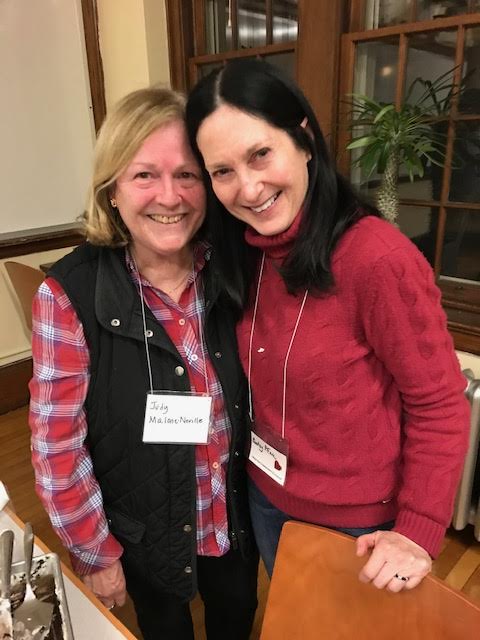
We wear name tags so any new person can know who we are and can always feel welcome. And I recently snapped a photo of Nancy, who first brought the Newton Community Chorus to my attention all those years ago. As an alto, she sits across from me. She is still at it after all these years. She never fails to ask about her former student, my David.
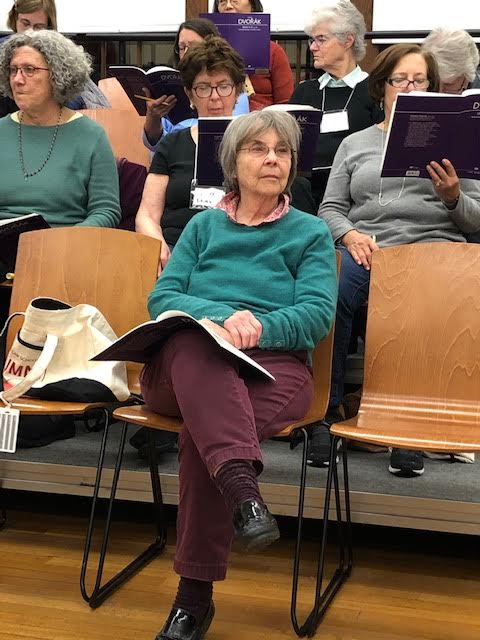
A year ago, he came in for Thanksgiving. Since he came all the way from London, he came in early and worked from the Cambridge Google office earlier in the week. I asked if he’d come to chorus practice to surprise Nancy. I texted him the directions and he showed up in time for snack. She was THRILLED to see him again after so many years. He’s a grown-up man now, well into his 30s. He was an elementary school child when she first met him. It was a lovely reunion and I even got bragging rights to introduce him to Rick, who could see the sweet scene playing out in front of him.
I have definitely found a fulfilling tribe with my chorus.

——————————————————————————————————-
Update: 36 hours before this story went live we received two emails, one from our chorus president, one from Rick, our director, informing us that, due to the coronavirus and State of Emergency declared by the Governor, all rehearsals and our May concert were postponed until further notice. While this is disappointing, it is the correct decision, as we sit close to one another in rehearsal and stand VERY close on the stage for performance (the tiny photo at the end of the story, lifted from the chorus website, newtoncommunitychorus.org). We don’t know what conditions will be like by May 9, the date of our concert, but if we can’t rehearse, we would not be ready to perform and we could not reasonably hope to have an audience, sitting next to each other, as they do in the historic church in Newton Centre where we perform. We can only hope that conditions will improve by the time next season begins after Labor Day. Stay safe, everyone!
Dan and I had already canceled our cruise though Spain, Portugal, France, ending in London to visit David, who is working from home for the foreseeable future anyway and expects to be in lockdown soon. This was scheduled to conflict with the concert, so I WAS now planning to perform with the chorus, as I informed Rick this past Monday. Everything is changing rapidly. But I can still write.
Further update: We came back! In the fall of 2022, our chorus returned, masked, proof of vaccination required, but sing we did! Only 43 of us returned (we sang three short Bach cantatas), but we had an orchestra and soloists for our January performance and started up the next week with the Brahms German Requiem (my third time), which we performed on May 10. It felt fantastic to be singing again (we got more people second semester and we performed unmasked; in fact, the Brahms is now so high in my vocal range that I couldn’t breathe with an N-95 mask on – I couldn’t get enough air, so I wore a less-effective surgical mask, and at times, no mask at all. I still have not gotten COVID, but have had ALL my boosters).